Okay, I think I’ve got this problem with throwing both the switch and the switch stand for the turnouts on the window sill licked! The trick was to think about the parts that have to move the same distance and to design something that would hold them rigidly together.
Then I remembered Pembroke’s Victorian or at least Edwardian roots, and realized that there is no problem that can’t be solved with enough wood, iron and rivets (or in my case Robertson-head screws). The contraption is shown below.
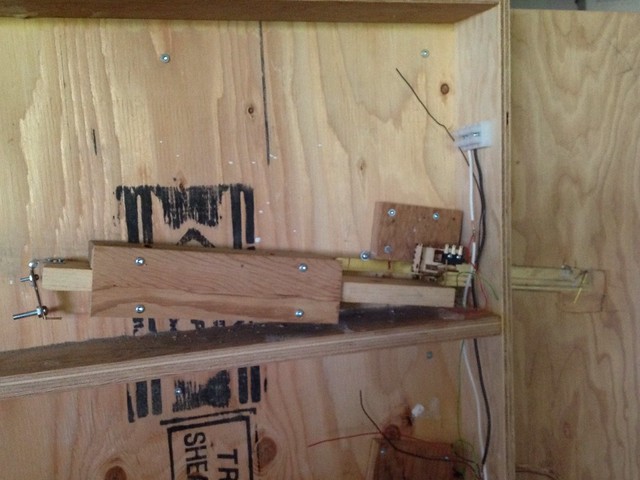
As you can see, I looked around the garage for something that wouldn’t flex too much and found a block of wood. I used this to replace the choke cable, which hadn’t been installed yet anyway, and this driving block pushes both the Bullfrog and the switch stand slider. The block of wood has a rod that connects with the Bullfrog, and a steel hook that connects with the switch stand slider. This is better than trying to transfer the motion from the choke cable through the Bullfrog to the switch stand slider.
The free end of the block of wood has a hinge, which will connect via some threaded rod with the turnout control, once that’s built.
One more to go, then I can put the south section away until it is installed.
 Pembroke:87
Terrific update and I got a real laugh out of: “…and realized that there is no problem that can’t be solved with enough wood, iron and rivets (or in my case Robertson-head screws).”
I need to settle on a means of moving the points on the three turnouts on my layout. I’ve been trying to read more and more about different methods and including the Bullfrog actuators. I like the Bullfrog and seem to be settling on it. Thanks for sharing some thoughts on their installation.
Thanks for the comment, Chris.
I chose Bullfrogs mostly after I decided I wanted manual control, and therefore discarded Tortoises or similar. Then it was really down to a decision between Bluepoint and Bullfrog (for me). Bullfrogs are inexpensive and made in Canada. Love them!
Terrific endorsement and I like the logic. Thanks!