Parts for 622 continue to appear on the drawing board. It’s easy to get carried away when you’re modelling in CAD. The keys that retain the springs, for example, are really miniscule – about .01 x .01 x .02. Will the 3D printer be able to resolve them? I hope so.
I’m wondering if I should combine the brake cylinder and suspension assembly into a single part. On the one hand, fewer parts are less expensive to print, and the glue joint has a greater chance of lasting. On the other hand, a single large part means I don’t have the opportunity to make minor adjustments to get the cylinder to mate with the rest of the brake system.
Looking back to the brakes, Craig Townsend commented that it looks like the brakes are applied as the piston is pushed out of the brake cylinder. I don’t know if they should be on or off, so I went and changed a couple of numbers on the brakes sketch, and effectively released them.
What do you think? Brakes on or off?
Brakes off: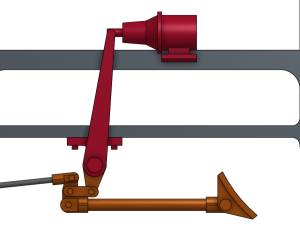 |
Brakes on:
|

 Pembroke:87
Hmm, there isn’t much difference between on and off. As a pro for brakes on it’s probably going to be easier to notice when not moving than when moving.
Or you could do one side brakes on and one side brakes off 🙂
Both? That’s crazy! Have you been talking to my kids? “Yes, we would like cake _and_ ice cream”
Cake and ice cream go together like bacon and… well just about anything maybe that’s a bad example. Ice cream cake is pretty awesome too.
Crazy would be having them removable so you could switch it out or even making them movable 🙂
Rene,
I’m kind of torn now that I raised the question in the first place… My vote is for brakes released.
When drawing the brake piston, in the released position the smaller cylinder should only be a couple of inches long.

See this picture of a modern locomotive with the piston released. See how small the piston is when the brakes are released. When the brakes are applied the piston travel is from 6-9″
Craig
Okay, let’s go for brakes released, then. I think we also need some representation of the clevis that connects the piston with the arm…