My first passenger car was 3D printed by accident. It started with the bullnose roof, which would have been difficult to craft. When I finally had the roof drawn, I started wondering how difficult it would be to draw the rest of the car, and then I wondered how much it would cost at Shapeways, which was a new service at the time. And while it wasn’t quite an accident that I hit “purchase,” it may as well have been.
I’ve never been very happy with the finish on the car, however. The Canada Atlantic passenger cars had decorative lining, and I reproduced that with a gold pencil to avoid the garish look that over-thick lining would have yielded.
I lay awake the other night with a million projects rattling around my head until three in the morning, and one of them was the next passenger car. There is no near-term plan for another passenger car, and some of the thoughts, like printed and Cricut-embossed car sides, will likely be tested on freight cars before I get here. However, I thought I would capture the ideas before they either disappear, or overwhelm other ideas.
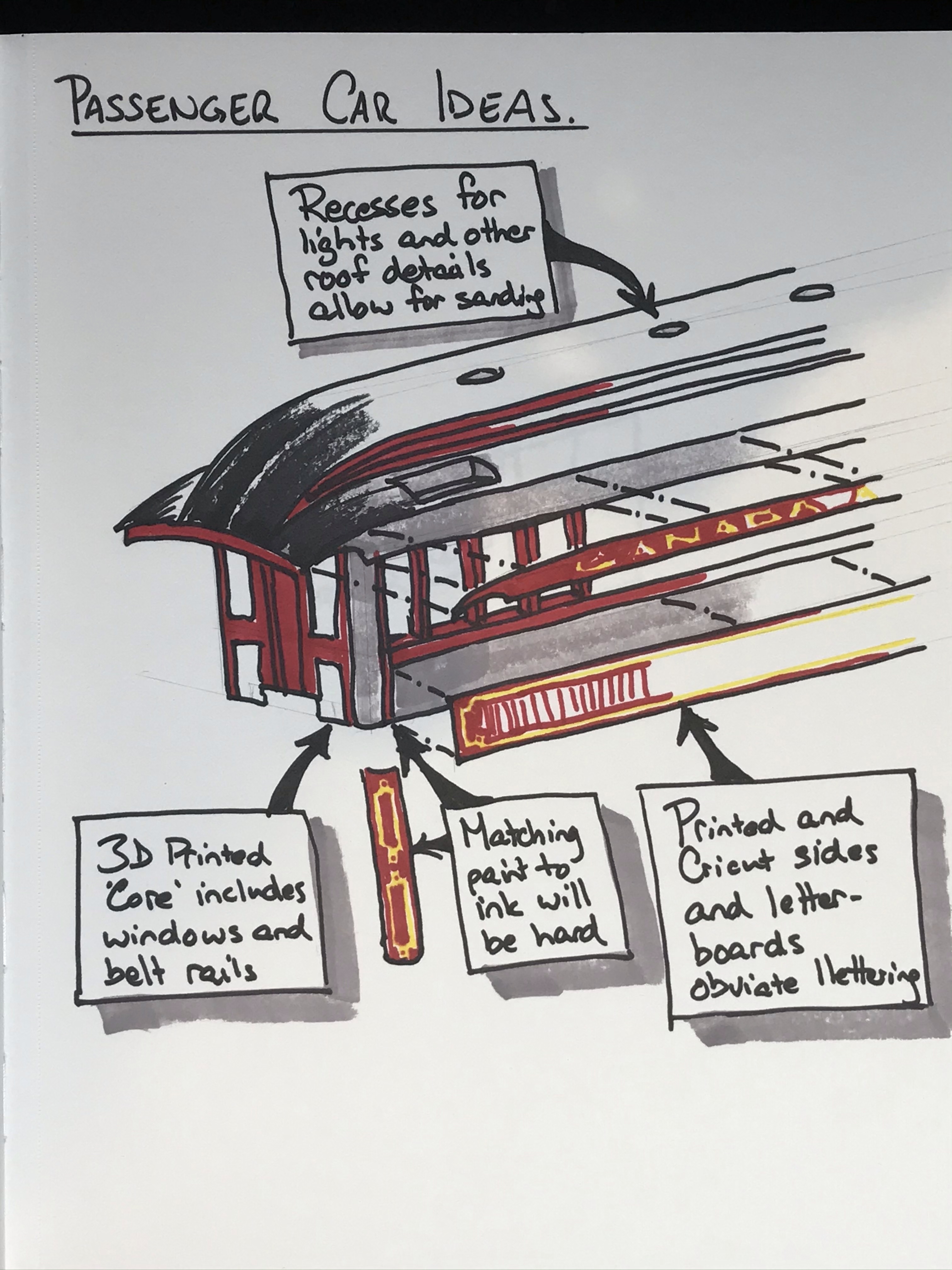
The key idea is to print and emboss the sides and letterboards with the lettering and lining in place. I would apply these to a 3D-printed core, which would incorporate the window frames, belt rails, doors and roof. A secondary idea is to make recesses to allow me to sand the roof (if necessary) and yet accurately locate the details.
There could be some challenges around curved sections on the corners, and where baggage doors intersect with the letterboards. Also, I’m unsure if I can match the painted sections of the car with ink from my printer.
 Pembroke:87
Take a look at John Ott’s website. He has a lot of experience in using printed sides for his freight and passenger cars. http://www.ottgalleries.com/
Thanks Bernie,
I was aware of his freight cars, but not his passenger cars. I’ll have a look.
Rene
Just thinking out loud:
– gold decals for the lining and letter board etc, plus
– plain decal film painted in the colour you use on the car can be applied over the edges of the gold lettering where you need to narrow the width of lines
– Cricut to cut the car-coloured decal masks.
– Magnification to see what you are doing.
I did wonder whether you could emboss real gold leaf onto decal film with the embossing capability of the Cricut, but imagine that would be too course compared to other methods. But for the corner posts, I wonder about real gold leaf as the first layer and coloured decal film as a mask over that. Probably overthinking it for HO scale . . .
Hi Rob, I don’t imagine it was gold leaf – more likely paint, I think. The lines are really faint in photographs, which makes me believe they were very fine – less than 6mm? So I’m aiming for the right appearance over the right colour.
Hi,
Congratulations on the great blog! I am also a CAR fan and have been researching it for a few years. The plan is to eventually model, in part, the yards around the Elgin Street Depot in the early to mid 1890s. I was wondering about paint colour for rolling stock, as I have not seen any colour photos relevant company paperwork. Any information you can provide would be greatly appreciated.
Hi Michael,
Welcome to the CAR enthusiasts club! Once you start modelling, we’ll add you to the modelling SIG, which meets regularly in the broom closet. AFAIK, there are currently three of us.
The 1890s are a fun time for the CA as some of the older cars were much more in evidence – like the Ottawa and Boston Lumber Line cars, which I believe were mostly gone by 1905. The only freight car reference I have is for “Metallic Brown” in 1903 (see my research site https://sites.google.com/site/canadaatlanticry/freight-cars?authuser=0).
I have a couple of tinted postcards that show one series of CA boxcars painted green. This could be fanciful tinting, but I am going to follow the information until I have better data.
Flat cars were painted in a couple of different schemes. Black, and a light colour with interesting drop-shadow lettering.
Passenger cars were “Turkish Rouge” as were passenger locomotives in your timeframe. See my old proto:87.org blog for the interesting story of Turkish rouge.
Good luck with your research! Please let me know what you learn so I can share it on the research site.
Thanks for all the great information! I’ve never designed a layout based on something historic. Also, there’s the issue of space, so mine will be CAR ‘inspired’ rather than closer to prototypical. That said, the Elgin St site offer lots of opportunity (station, roundhouse & turntable, the canal with its swing bridge to name just a few). I’ve only partial photos of the station, but I think enough to get close. I look forward to reading more of your blog. Happy modeling!
You should check out Colin Churcher’s railway pages for more views of the Elgin St station.
I have checked out Colin’s pages. They are a great source for a vast array of inform. So far, the Elgin Street station building remains rather enigmatic. Even Colin hasn’t found full photos of it. I was at the National Archives when Covid hit, looking for more. Perhaps, I’ll find something that others missed once I get back. I also haven’t been through the city archives yet. However, with a couple of partial photos and some exterior dimensions, I should be able to build something reasonably close.
Oh, you’ll get used to that if you’re modelling the 90’s
I agree and think I’m already used to it. Fortunately, I’m going for historically inspired as opposed to historically accurate. As a plus, I enjoy doing the research whether or not I find exactly what I’m looking for.