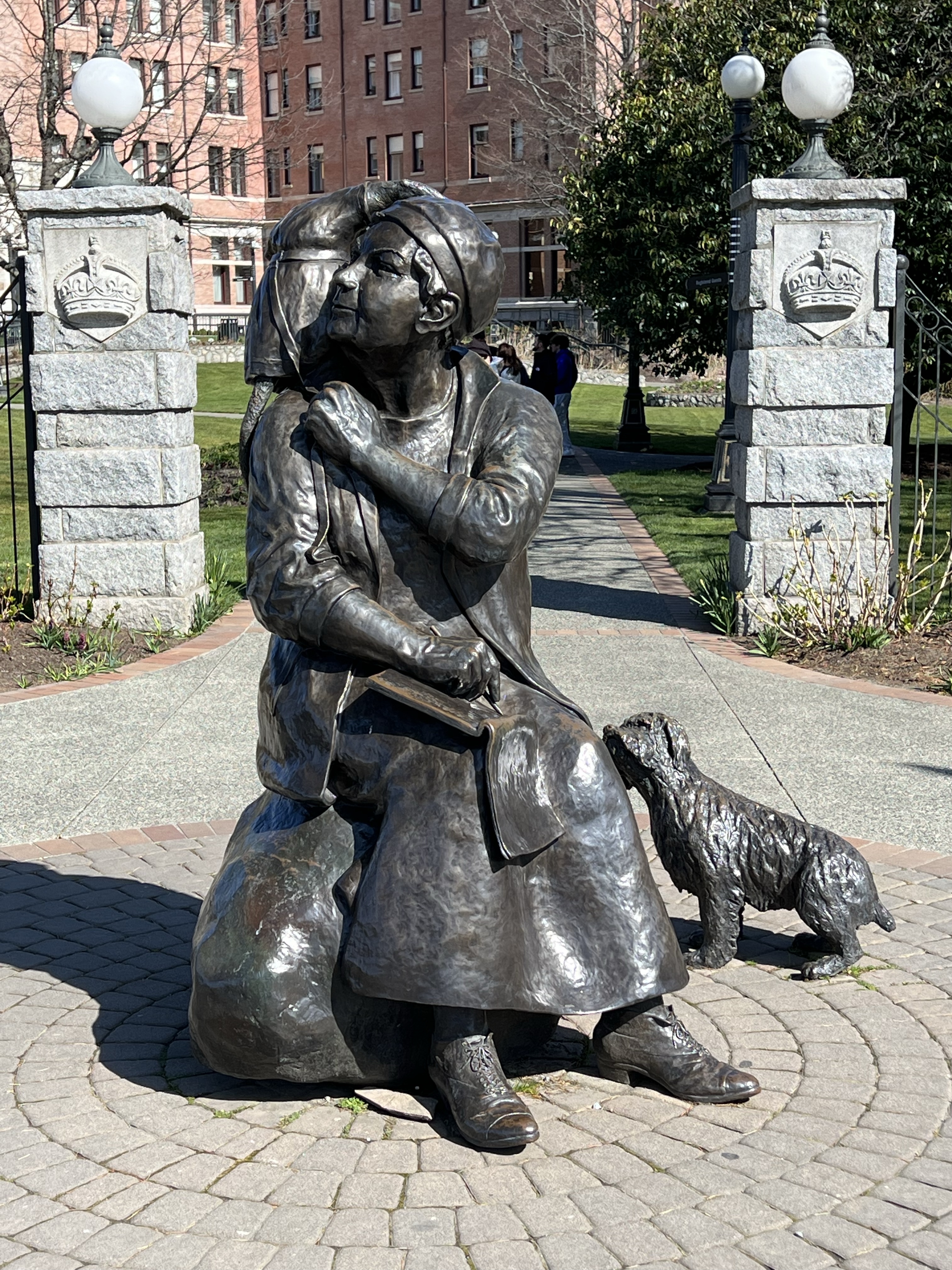
During March Break we took a weekend break in Victoria, a short Ferry hop across the Salish Sea. We found ourselves sitting beside the statue of Emily Carr sketching on her corner opposite the provincial legislature, when a little tour group came by. The guide gesticulated vertically toward the statue, and enthusiastically expatiated in some middle-eastern language while then taking the group around the side and then the back.
Well, we had to see what the fuss had been about, and so, when the group had moved on to the Empress Hotel, we shifted to Emily’s front. There it was plain: she was pointing out the strong vertical line of the artist’s coat, and its intersection with the diagonal formed by her hands, the leash and her gaze. This line almost forces you to walk around the statue to discover the monkey, who is in turn looking at a little dog by the artist’s feet.
Now, I’ve read enough books about composition to know about leading lines, positive and negative space, rules of thirds and all that. But almost all composition books focus on two-dimensional art, and while applicable to railway modelling, I feel they tell only two thirds of the story. What I have read about composition in sculpture suggests that you should use the elements of composition to invite the viewer to interact with the piece in some way.
This statue of Emily Carr, thanks to a chance encounter with a guide who spoke a language I don’t understand, was the first time I’ve understood what that means. You cannot see the whole story without walking around the statue, and the strength of the leading line up to the monkey all but forces you to walk around to the back of the statue. That is the interaction the sculptor sought to create, and the type of interaction we can seek to create in our model railways.
 Pembroke:87
One thought on “A Lesson in 3D Composition”