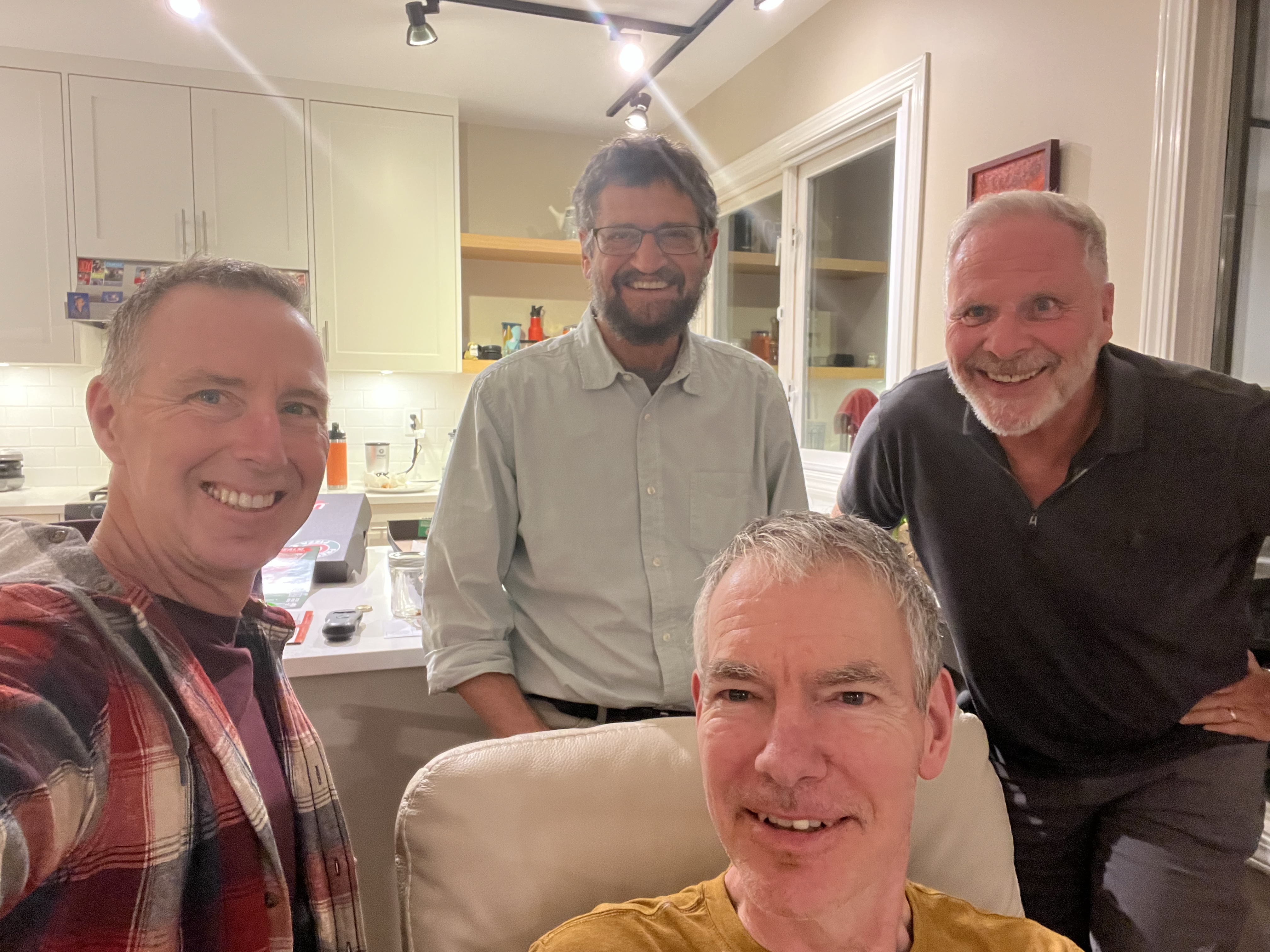
On Thursday, my friend, Mark Dance of Columbia and Western fame invited a few of us over for an evening of pizza and beer and talking about model trains. The question he wanted to discuss was whether model railroads can be art, and what are the implications if they are. It was a fun evening, and we stuck surprisingly close to the topic.
The first challenge of the evening was, of course, the question of what art even is. Fortunately, Gary had prepared on the bus by reading the Wikipedia article about art. With his expert help, we concluded that art is something that elicits an emotional response in the audience or viewer. We decided, furthermore, that good art evokes a strong response for a broader audience.
This definition is different than the big idea definition that I landed upon the last time I discussed this question, but I think I like it better. That it provides a measure of good art, and gives us something to strive for is especially powerful. Even so, I’m not going to take down the quote from Sir Wilfred Laurier.
The 20th Century shall be the century of Canada… For the next 100 years, Canada shall be the star towards which all who love progress and freedom shall come.
Sir Wilfred Laurier, 1904
One of the interesting aspects we discovered about this definition is that it depends on the audience, and that model railroads have several distinct audiences, who have vastly different experiences of a layout. On the one hand, there is the casual visitor, who might recognize it as a model railway, and marvel at the amount of work that went into it. Then there is the railway enthusiast, who will recognize the prototype fidelity of the scene and the equipment. Lastly, there are the operators; it’s as if we invite the folks in the front row up to perform the show!
Each of these audiences will have a different but intertwined experience of the layout: the operator will have time to consider the prototype fidelity of the equipment and scene, and the railway enthusiast cannot help but see the context in which the models are presented. It seems, therefore, that there is a greater chance of success if the feelings reinforce one another.
In the case of Pembroke, the feelings that align with The Big Idea are industriousness and optimism. At the dawn of the 20th Century, Canadians believed they could achieve anything if they worked hard enough. And the work was hard: almost everything was human or animal-powered. Considering the three primary audiences and the scene so far, how can I elicit these feelings of industriousness and optimism?
For the casual viewer, I’ve already written about the idea that the layout builds from right to left, ending in a riot of urban modelling at Pembroke Street where the buildings are predominantly stone or brick. Downtown Pembroke, like most towns and cities at the time, was an unchecked mixture of industrial, commercial and residential buildings. After our discussion, I’m now thinking that adding industrial sounds to some of the buildings might drive the feeling of industry home, even though I’ve never believed in ambient sound before.
As for optimism, I’m glad I chose a sunny summer’s day when I painted the backdrop all those years ago. I still have more lighting to add, but the bright, cheery mood should transfer over to the viewer.
When it comes to the railway enthusiast audience, the Canada Atlantic presents an interesting challenge: almost nobody knows about this railroad, especially here on the west coast. In fact, I might be the only one in the world who cares about the prototypical accuracy of my models. However, any railroader will recognize the state of repair and level of weathering, and these have been thankfully in line with an optimistic and industrious railroad.
Finally, there is the operating audience. Up to now, my guiding principle has been that the mechanics of the railroad should be manual. That is why the switches are thrown with levers, rather than push buttons, and why I aim to provide a throttle to both the engineer and the fireman. However, this merely reinforces the feeling of hard, manual labour.
Pembroke’s schedule of six trains a day, plus an extra whenever I invite the front row up to perform the show, should reinforce the feeling of industriousness. The feeling of optimism, however, I don’t know if I can elicit in operators, and I’m open to ideas.
 Pembroke:87
Thanks for the post Rene. I have to say, this one one of the more enjoyable evenings I’ve had in some time, even if I had to do “homework” to prepare for it. Leave it to Mark to make us think! 🙂
A few follow-up comments if I may: 1) I think you left out one important audience member: the layout creator. How do our creations impact us along the way? What emotional connection do we have to our own creations? 2) Trying to convey the experience of hard manual labour is fascinating, and it ties into a comment Mark made that has really stuck with me: “model railroads should not have control panels.” There is nothing prototypical about them. It’s an especially timely comment for me as I decide how I want to control the turnouts and derails in my industrial trackage. I would like the experience of switching these tracks to feel authentic (and time-consuming), which means locks and hand throws as close to in situ as is practical in N scale.
Thanks for the reminder about the fourth audience: there is a whole blog post in there!
I’m looking forward to seeing what you come up with for your industrial tracks. It’s bound to be an improvement on my efforts.