While almost every derailment on Pembroke can be traced to a gauge problem – typically too tight – a couple of sites continue to defy explanation. Backing south into the heel of the south siding switch, for example, the rear (now leading) drivers of 1120 gently drop off the rail and onto the ties. Going forward is no problem, only backing movements derail. I spent a monkey’s age with the track gauge chasing ghosts in that area, and eliminated all the tight spots. Yet the derailment stubbornly persists, so there must be some other problem.
Every Canadian city needs a P4 modeller, and when I arrived in Vancouver, John Moore was ours. One time when I visited him, I noticed a wagon built from a clear piece of acrylic, which he called Perspex of course. The wagon had two rods that passed through the acrylic from the W-irons and nearly met at a point above the middle of the wagon. This, John explained, helped identify rough spots in the track where one rail rose relative to the other – places where the track twisted.
W-irons are not in my kit bag, and though I could have used two trucks where John had used W-irons, I felt this would increase the tolerance in the tool. After taking many walks and showering numerous times, I came up with the design shown.
Using my best tool for precision work, my lathe, I fashioned two rollers to fit between the rails. I threaded them onto a rod, and soldered another rod perpendicular(ish) to the common rod. Then I bent the common rod up parallel to the perpendicular one. The roller closer to the two vertical rods rotates freely around the common axis. Of course it doesn’t roll, but by pushing the Trackwork Torsion Testing Tool (TTTT)(TM)* down the track, you can observe the needles moving relative to one another. Variances as tiny as the thickness of a piece of paper are easy to observe.
In the case of my derailment, the TTTT(TM) shows that the outside rail rises slowly relative to the inside rail, and then drops suddenly just before the frog. Now all I have to do is figure out what to do about it!
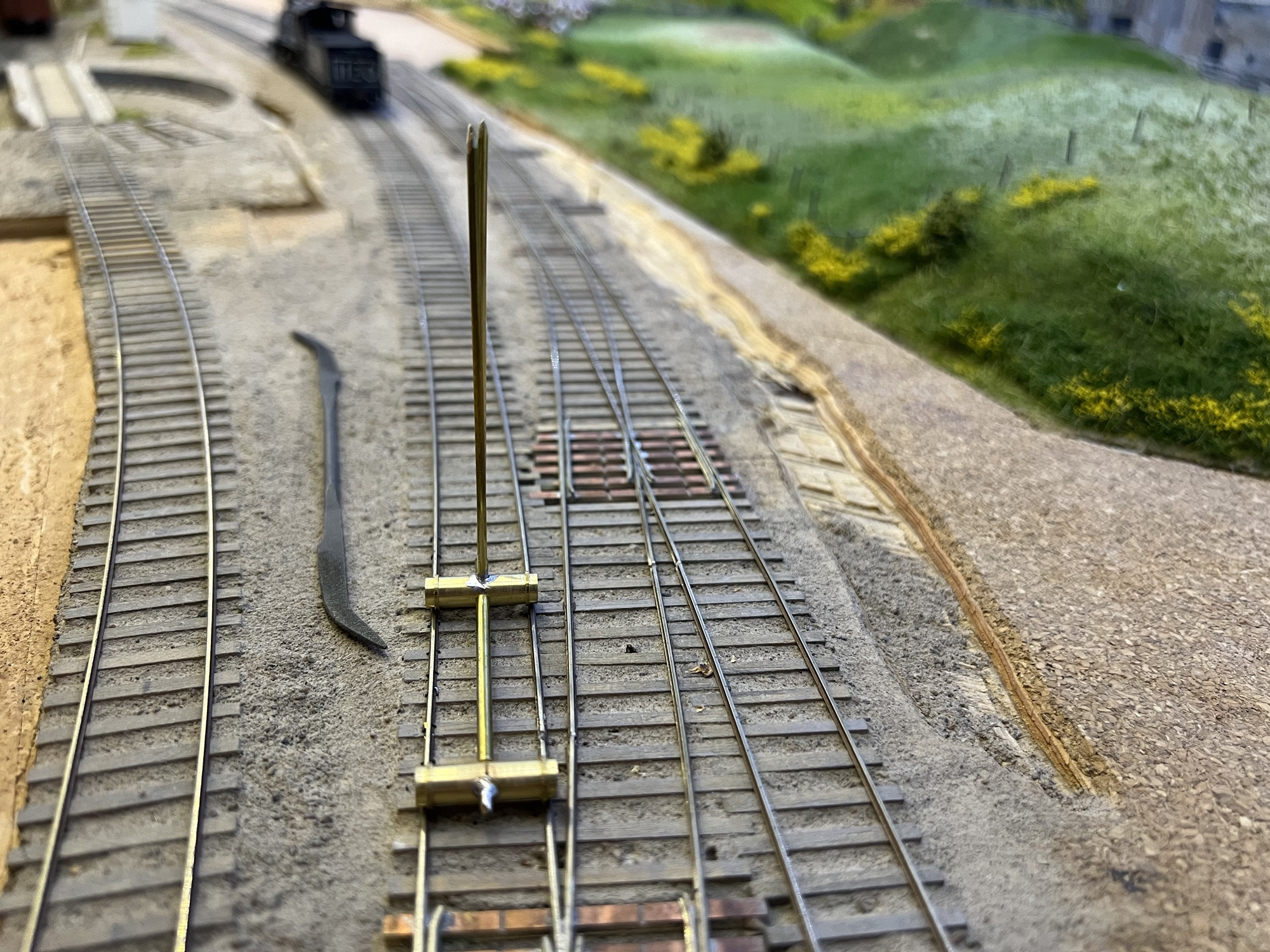
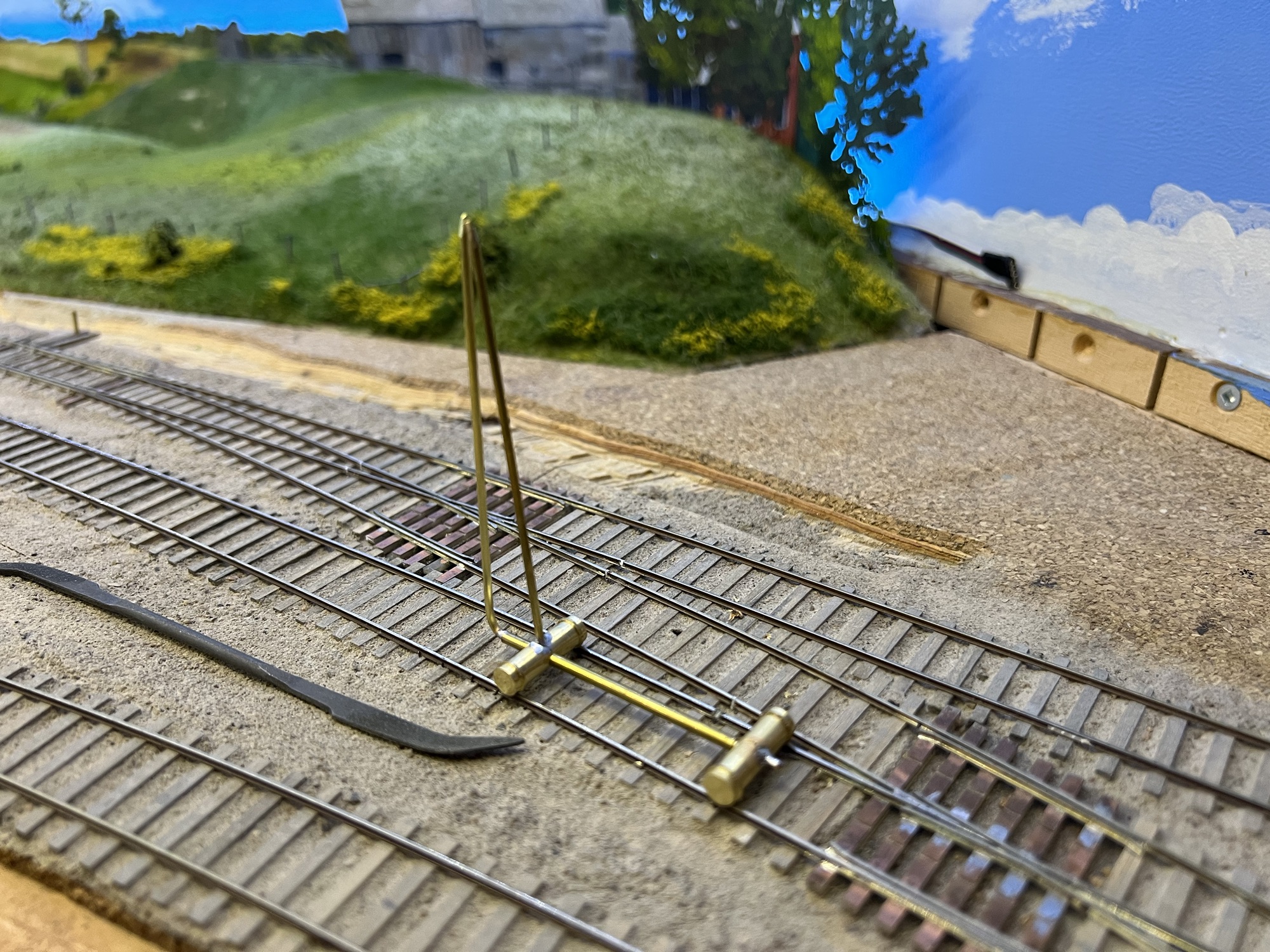
*Note: I haven’t actually got a trademark on this name, but it was too fun to leave it out!
 Pembroke:87
That’s wonderful. I need to figure out how to make one for three rails.
That’s wonderful. I need to figure out how to make one for three rails.
NMRA RP25 specs are tolerant of cross-level variance that Proto specs will not tolerate. Having an almost 25 thou flange depth allows for a variety of tracklaying sins that will surely derail a Proto:87 model. It’s no wonder that the UK Protofour/Scalefour, etc folks are into using very flexible loco suspension. This tome goes into some detail about suspension, with mathematical formulae a part of the work—
http://www.clag.org.uk/41-0rev.html
UK firm PenBits offers kits for springing commercial model loco bogies.
https://www.penbits.co.uk/
Though I am surprised that an American Standard 4-4-0 or a 4-6-0 might have trouble on a layout; the types are considered rather tolerant of track level variance.
Steve Lucas
Thanks Steve. The trouble with 4-4-0s is that they tend to want to tip onto their front drivers anyway, so they’ll take any excuse to raise a back driver. As one rail drops away, I’m left with the rigid chassis riding on three wheels, which apparently are happy to go straight rather than follow the curve. A compensated or sprung chassis might have performed better here.