Even today, locomotives want a small amount of dry sand for traction. All my resources are tacit about where they kept engine sand in Pembroke in 1905. There is also zero information about the purpose of the third stall in the roundhouse.
For years, I’ve thought there was probably a pile of sand somewhere and a small bunker inside the roundhouse where it would dry out, and probably be sifted for weeds. Then, while the roundhouse was off getting a new floor, and I was considering the location of the bunker, I noticed there is a large space between the second stall and the mysterious third stall. Putting zero and zero together, I reasoned that perhaps one of the uses of the third stall was to unload sand. I don’t imagine there would have been more than a few carloads of sand per year, but there was certainly room.
The roundhouse floor has now sprouted a lumpy styrofoam rectangle, with a wooden bunker around it. This provides a reason to very occasionally push a gondola into the roundhouse, and also resolves the mystery of engine sand.
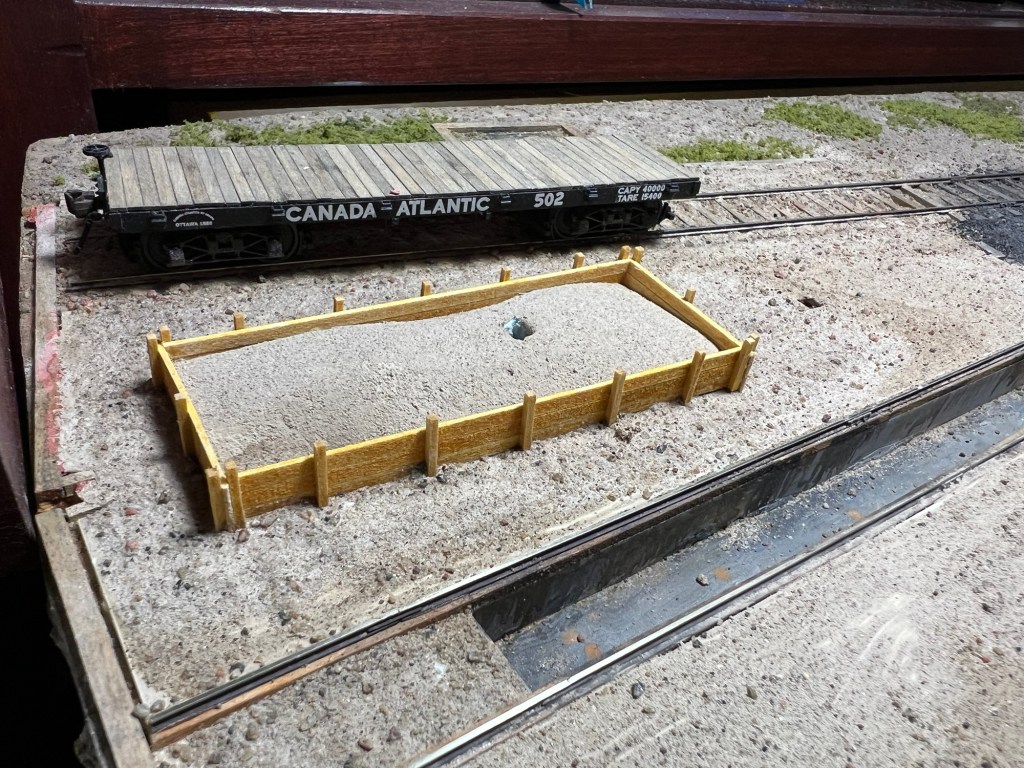
 Pembroke:87
It makes sense that they would keep it inside, out of the weather. Might there be a small bucket crane inside as well?
Say, are those bolted rail joiners in that photo. Have you done that consistently along the line?
Nah, I doubt there was a bucket crane to unload every few months if they didn’t have one for coal!
Yes, rail joiners on this module. Once derailments are resolved I will have them everywhere (and maybe spikes too, but I’m not convinced those look right)
I’ve approached one gent who offers some excellent etched loco and track parts, enquiring if he was interested in making HO scale 24″ long toed joint bars. Toed joint bars have that small lip along the length of the bottom of the bar that follows the base of the rail. So far, this feature appears impossible with current etching techniques.
But these things are such a common joint bar of the time that they call out to be modelled in track. 3d printing perhaps?
Steve Lucas
I made some on Shapeways, which I believe have the shape you’re referring to. They’re only appropriate for Proto:87 on code 55 rail, though. The source file is long-gone, but would be easy to reproduce.
How would the sand be delivered to locomotives inside the roundhouse?
Craig
I imagine a bucket. I don’t think you’d even need a wheelbarrow.
The next challenge stands to be modelling that sand. An interesting challenge in 1:87.1 scale
I’ll pay attention to how you model sand!
Steve Lucas
I used some sanded grout. It is almost certainly overscale but has a nice grainy texture. Matte paint would probably be to-scale.