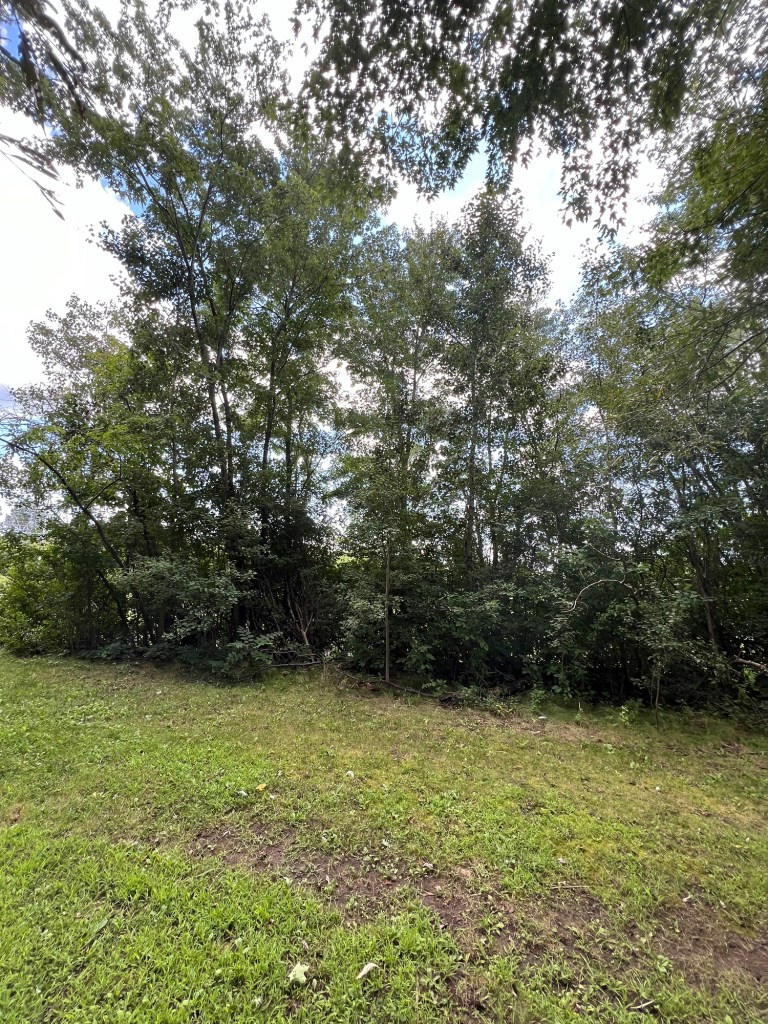
The Girl and I are travelling around Ontario this week, looking at universities. On the long drive from Ottawa to Fake London, there was ample time to ponder how the landscape has changed, even over my lifetime, and the implications to modelling Pembroke in 1905.
The most alarming change has occurred in the past ten years as the emerald ash borer dug its way from a shipping container in Michigan and decimated every forest on its inexorable march across the continent. The deciduous forest here is heterogeneous, and so the ash borer kills individual trees rather than leaving a whole hillside for tinder as the pine beetles do in BC. However, The ugly bleached trunks and snags of dead trees mark the ash borer’s path through an otherwise healthy forest.
Another introduced species has a beautifying effect. Shortly after I moved away, thirty years ago, purple loosestrife invaded the ditches and fallows of my first province. Nowadays, it is so rare to see a meadow that is not a pretty purple, I forget what should be there. It would be tempting, though inaccurate to portray fields of these flowers on Pembroke.
I’ve been looking for meadows because I need something to put in front of the coal dock and water tower that won’t completely occlude them. However, as I was passing a field of round bales of hay, and reflecting how they used to be square, and before that, not baled at all, I realized that a field free of trees would have been too valuable to leave as a meadow in 1905. It would be pasture or hay or some other crop.
Hay, I think. But that begs a question: what would a field of hay have looked like in 1905? I sense another rabbit hole looming. Hopefully, it is the form of a snowshoe hare (which don’t have burrows like European rabbits), rather than a white-tailed jack rabbit, because those weren’t around in 1905 either.


 Pembroke:87
Hi René,I can’t speak with much authority
LOL, neither can I but I’m pretty good at looking up stuff in Wikipedia!
The new(ish) block editor seems to have truncated my comment!
I’m super-excited to read the rest of it!
I can’t speak with much authority on wheat at all, and even less on Ontario, but I vaguely recall that in MRJ 10, Tim Watson commented that wheat used to be taller and also with lower yields. This ties in with Norman Borlaug’s work on semi-dwarf high-yield varieties of wheat from the middle of the 20th century onwards.
Hope that helps a bit – if nothing else, it might provide some starting points for a web search (and yet another rabbit hole!*)
Regards,
Simon
* I find these rabbit holes a delightful excursion but also a great example of what’s good about our hobby – we are driven to discover so much more about the word around us than might otherwise be the case!
well, I don’t know of a time 124 year old time capsule for the sorts of landscape images you’re needing, but I have a rabbit hole that might be worth a bit of time. The Everett Baker colour slides (from the 1940s and 50’s) show rural prairie life. Not the same as Ontario, but a search using the word “hay” produces some results that may give you an idea. Only a different climate, different geography and 40 years of change from your Pembroke layout . . . https://everettbakerslides.smugmug.com/search/?q=hay&c=photos&scope=node&scopeValue=gSktk#i=0
Thanks Rob. This reminds me of the Prokudski-Gorskii collection at the Library of Congress https://pembroke87.ca/2016/04/23/colour-of-the-steam-age/, which has a number of photos of haying https://www.loc.gov/pictures/resource/ppem.01532/?co=prok.
Here is an example of prairie wheat in the 40’s https://everettbakerslides.smugmug.com/Photography/1940s/i-JkWxTJr/A