The land around Pembroke was settled about sixty years prior to 1905, and before that, it would have been forest. So a cleared area would not have been allowed to go fallow unless it were unproductive. Meadows are a recent addition to the Ontario landscape.
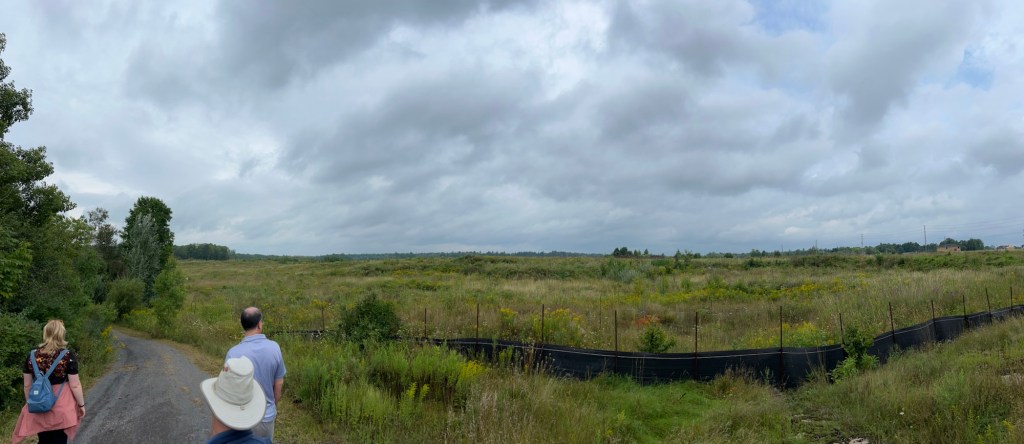
Having said that, there is space in front of the engine facility where trees would be appropriate and accurate, but inconvenient. So, while visiting my family in Ottawa this week, I kept my eyes peeled for open spaces to inspire areas at the front of the layout. I found lots and also learned that my brother knows a surprising amount about the progression of these spaces.
So, although I photographed fields of jolly Queen Anne’s Lace, I learned that this wild carrot does not propagate well unless the field has been mown. I found another meadow broken by raspberries, but these take a decade or more to get established after the land goes fallow.
I also had an opportunity to visit with my uncle, who is old enough to recall haying by horse on his father’s farm in New Brunswick. He confirmed that hay was one of their only cash crops in the 30s and 40s, and that they planted Timothy and clover as many farmers do now. A little web search reveals that was common by the late nineteenth century as well. So the field would look similar to a modern field.
A half-hour of web searches in the Ottawa airport reveals that in 1905, a farmer would have cut the field with a side mower, raked with a dump rake, and stacked it by hand on a wagon and either baled it for transport or more likely stacked it directly in boxcars. I found a video (https://youtu.be/D6G44KmMO8g?si=Ug-accO0QXwz2Ymr) that demonstrates traditional mowing. A short video of a dump rake (https://youtu.be/NeIfwIW-aOU?si=sFXpoVS3YkngX4cr) illustrates how far apart windrows were with this machine. It is tempting to include a hay-making scene in front of the engine facility.
 Pembroke:87