The photo of the wire fencing last week demonstrated to me that there is no avoiding the need for spikes holding the rail to the ties. Without them, and with no tie plates (as is appropriate for 1905), the rails look nude.
I’ve made spikes two ways in the years I’ve been at this. Back around 2000, I described a method to make plastic spikes in the Proto:87 Journal. My approach was to insert .010″ plastic rod into holes poked into the ties, cut them off .030″ (3/4 mm) above the surface of the tie, and bend them over with a soldering iron. You have to be quick with the iron or you vaporise the spike! The .010 rod I used was brown, and so, they look okay raw, but they’re better painted.
The second approach depends on the stainless steel scale spikes sold by Proto:87 Stores (proto87.com). In the past, my approach with these has been to drive them into the ties much as I would the overscale model spikes from Micro Engineering and the like. Half the spikes spring out of the pliers and into the ether, the other half bend before going in, another half slip out of the pliers and disappear in the ballast, and the remaining half actually go in and look okay, if the paint hasn’t chipped off in the process.
This approach is so labour-intensive, there are only a few sections of rail spiked down. The benefit is that the spikes actually hold the rail in place, which can be a boon if it doesn’t want to stay put.
Most of the layout, though, only needs cosmetic spikes. I conjectured that the steel spikes could be inserted into pre-poked holes, and maybe that would be as fast as the plastic spikes.
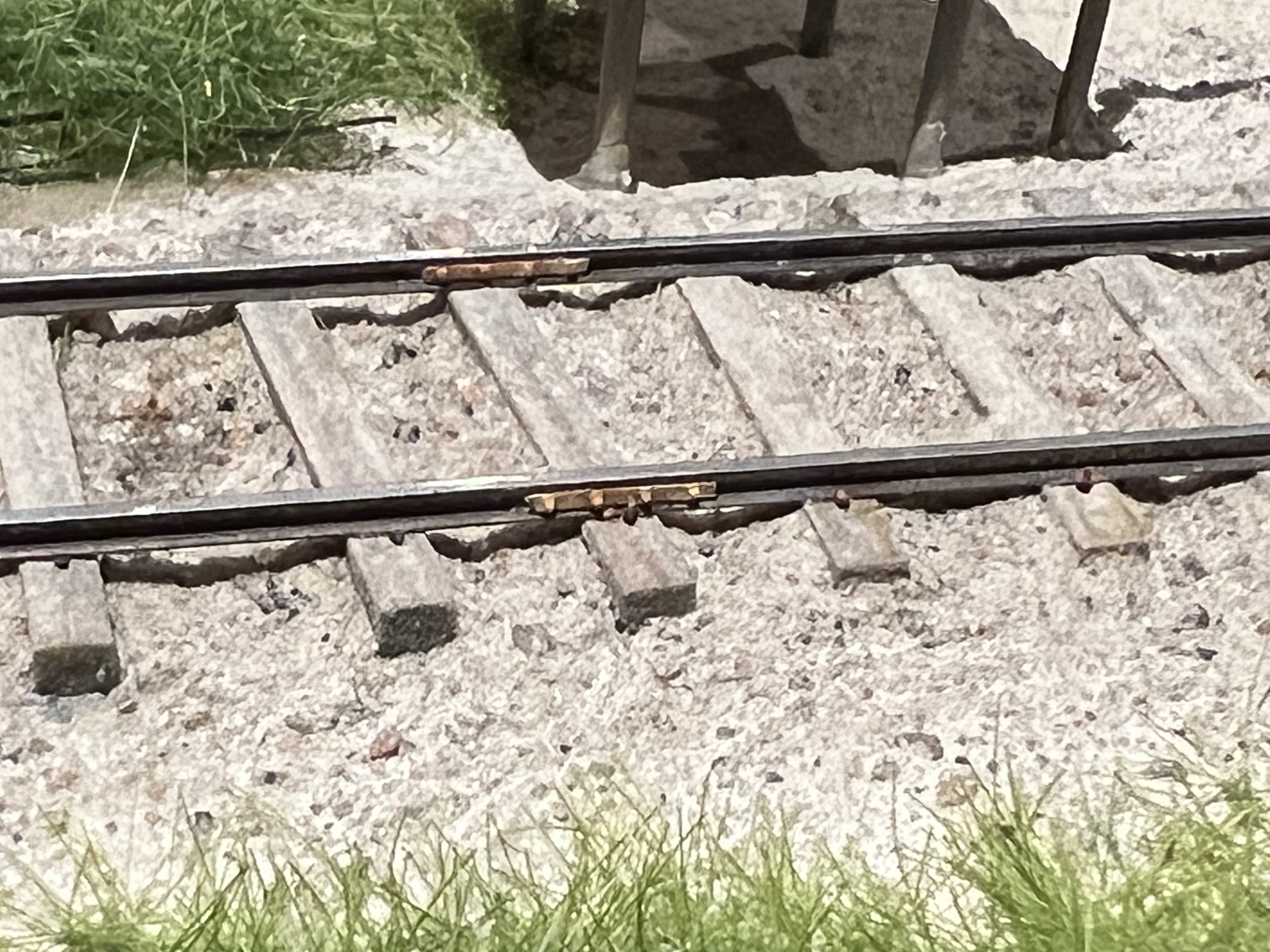
So, with the cattle chutes spur off the layout, I set up an experiment to see which was faster. I put steel spikes down one side of one 33′ piece of rail, and plastic spikes down the same side of the next piece of rail. Counting all the time from poking the holes to driving the last spike, the dozen or so steel spikes took seven minutes and 53 seconds. On the plastic side, the operations took eight minutes and 57 seconds, and the spikes had not yet been painted.
So we have a winner. The only problem is that Andy at Proto87.com is no longer selling the stainless steel spikes.
 Pembroke:87
Rene – You’re a zealot!! Have a very Merry Christmas and great 2025!
Jim
Rene – You’re a zealot!! Have a very Merry Christmas and great 2025!
Jim
Such a compliment! Thank-you. Merry Christmas to you also!
I guess you could etch your own stainless spikes? Given the availability of semi-scale size is very limited, there might be a few people who would like to piggyback on an order.
I’m half-tempted to start my own P87 store sometimes! 😂
KV Models has Code 55 joint bars (https://kvmodels.com/joint-bars/ ) although they could be too modern for your era. Perhaps they would be game to do etched spikes for you? I am somewhat surprised that Fast Tracks or Oak Hill Model Railroad Supplies don’t offer scale (or even non-scale) spikes.
Those KV Models joint bars are nice! I’m going to continue to use my own, however, as the Canada Atlantic ones had all the nuts on the outside of the rail. More modern practice is to put half the nuts on the inside so they don’t all get sheared off in an accident.
Plain steel guitar string.
How to form the heads efficiently?
With .007″ I cut the head at an angle and push them in with a screwdriver. Easier annealed. Back in the day when a trip to the hobbyshop was a twice annual event I made HO spikes this way albeit with slightly larger wire. I bent them then cut them to length with nippers. Wadded masking tape for a stop. Works for code 100 brass, steel and NS and codes 83-40. Doesn’t work so good with three piece ties since it splits the end grain.