Following last month’s experiment with the stupidly fine wire, I’ve gone on to refine the technique and produce enough wire fencing to keep any future cattle shipments enclosed long enough to get them aboard the stock cars. It’s still remarkably difficult to work with this material that I can barely see and that seems to have a mind of its own, especially when abetted by prematurely-installed grass. However, I think this aspect of the model has come to its conclusion at least for now.
To produce the fencing material, I used a jig, or perhaps more accurately a loom. I cut this from 1/8 plywood, but if I were to make another I would use acrylic or some other material that allows the wire to slide without catching. The loom holds the wires at the distances described in the Canadian Government Railways drawing. It makes about 10 inches / 25 cm of fencing, and frankly, that’s about enough to handle in one go. Trying to handle more wire than that leads inevitably to kinks and tangles.
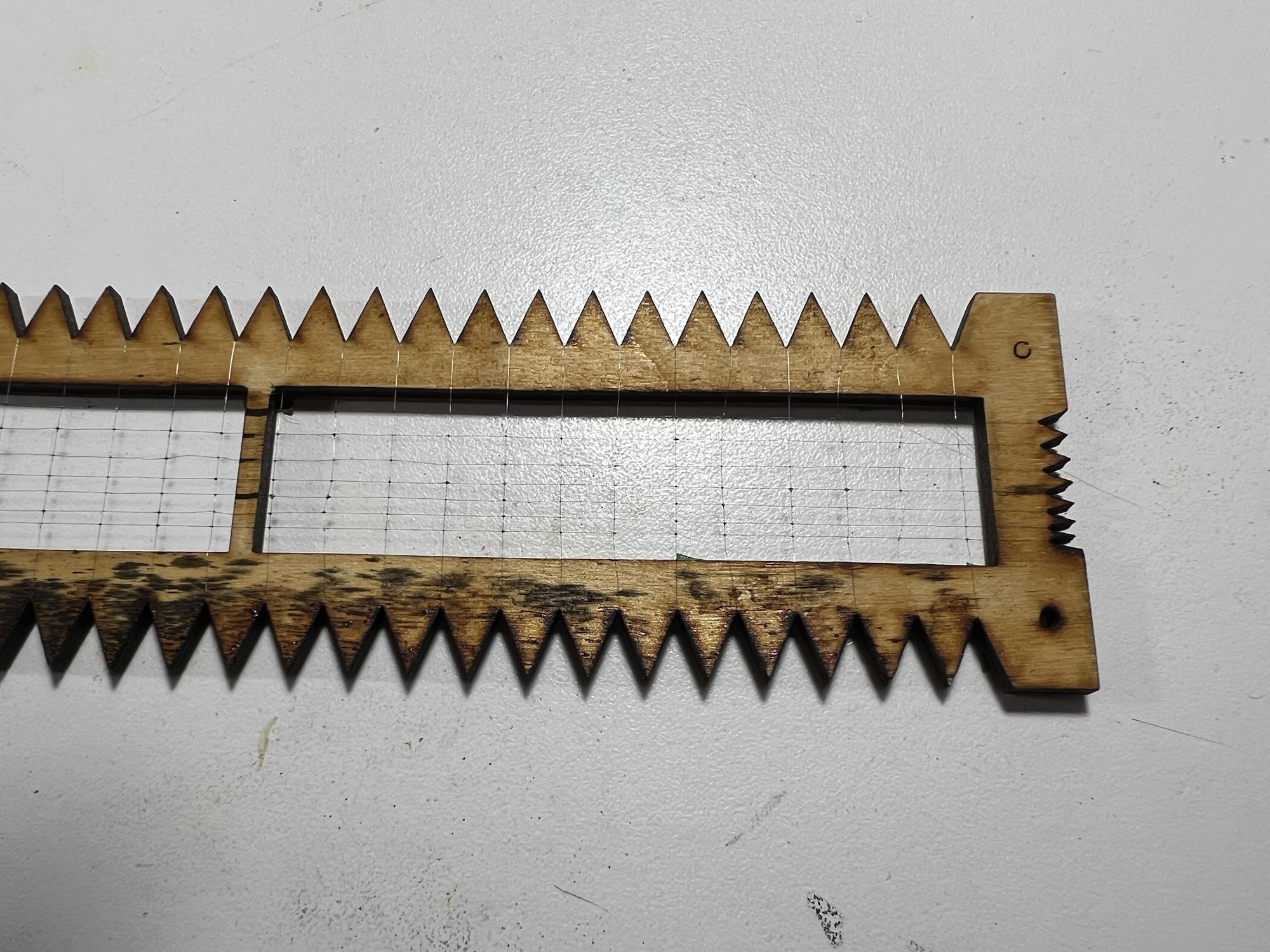
Here are some things I learned while weaving three lengths of fencing:
- Load the vertical wires first. The wider gap between them makes it easier to weave the horizontal wires than the other way around.
- For the vertical wires, cut about a 10″ length of wire, and tape one end below the next notch. Pass over the notch to the notch on the far side, then under, and repeat until the wire runs out. Then tape the other end to the back. The bends in the wire help to hold it taught so the tape is not taking much strain.
- For the horizontal wires, cut slightly too much wire and tape one end inside the notch. Then use your off hand to organize the big loop of wire and try to keep from getting hung up on anything. Use tweezers to guide the end of the wire over and under the vertical wires.
- I tried several approaches to colouring the wire. I wanted to stay away from paint as it would thicken the wire. Being stainless steel, it was unremarkably difficult to stain or oxidize. I ultimately landed on running it over a Sharpie marker. The Sharpie needs time to dry so cut a few lengths of wire and let them dry, then replace them as they are used. The ink will dry in the time it takes to thread a couple of the horizontal wires.
- Use very thin CA (Lepage’s Pro) to deposit the tiniest drop at each wire junction. The loom is broken into three sections, and by the time I get to the end of one section, the CA is starting to thicken and I need to clean my pin and start a new puddle on my glue tray.
- After the glue has dried, you can touch up any Sharpie that rubbed off. Do not go over the glue joints as you risk breaking them.
- Use scissors to free the fencing from the loom, cutting as close as possible to the top and bottom wires.
I’m still honing the installation method. However, I have learned the following:
- Best to install before any grass or scenery material is in place to complicate matters.
- The most successful method is to place the fencing under very slight tension and then put tiny dots of thick CA where some of the wires cross each fence post.
- I am unhappy with the concave corners as the material doesn’t bend easily. If I have to make concave corners again, I’ll try cutting the fencing at the corner.
- Try not to have joins in the middle of a run – save them for the corners.
Overall, the wire fencing is an improvement over nothing. Each 25 cm length of the material took about an hour to weave, so the jury’s out as to whether the rest of the wire fences on Pembroke will get this treatment.

 Pembroke:87
Rene,
This looks more like woven wire fence than anything `else I’ve seen. The loom did the trick.
John King
Thanks John
It’s really quite unbelievable that this fine appearance is achievable in HO scale. Now I think we will have to add a weaving course at RMMBC . . .
As I was working on it I kept thinking that I was solving problems that were solved 1000s of years ago!