At the end of summer, a wheat field should be a beautiful golden straw colour, and the seed heads should be well-formed and heavy. My research indicates that the varieties available in 1905 were taller than those we have today, which themselves are waist-height.
Initially I thought I could make use of a Silflor grass mat I’ve had in the attic for more than twenty years. It is unfortunately their “autumn” colour, rather than gold. I tried colouring it with a spray paint, but it was impossible to penetrate deeply enough without coating the tips too thickly. The result does not look at all like wheat, and the paint droplets are clearly visible. I’ll keep using it for goldenrod, and the hay field is using a big piece of the mat.
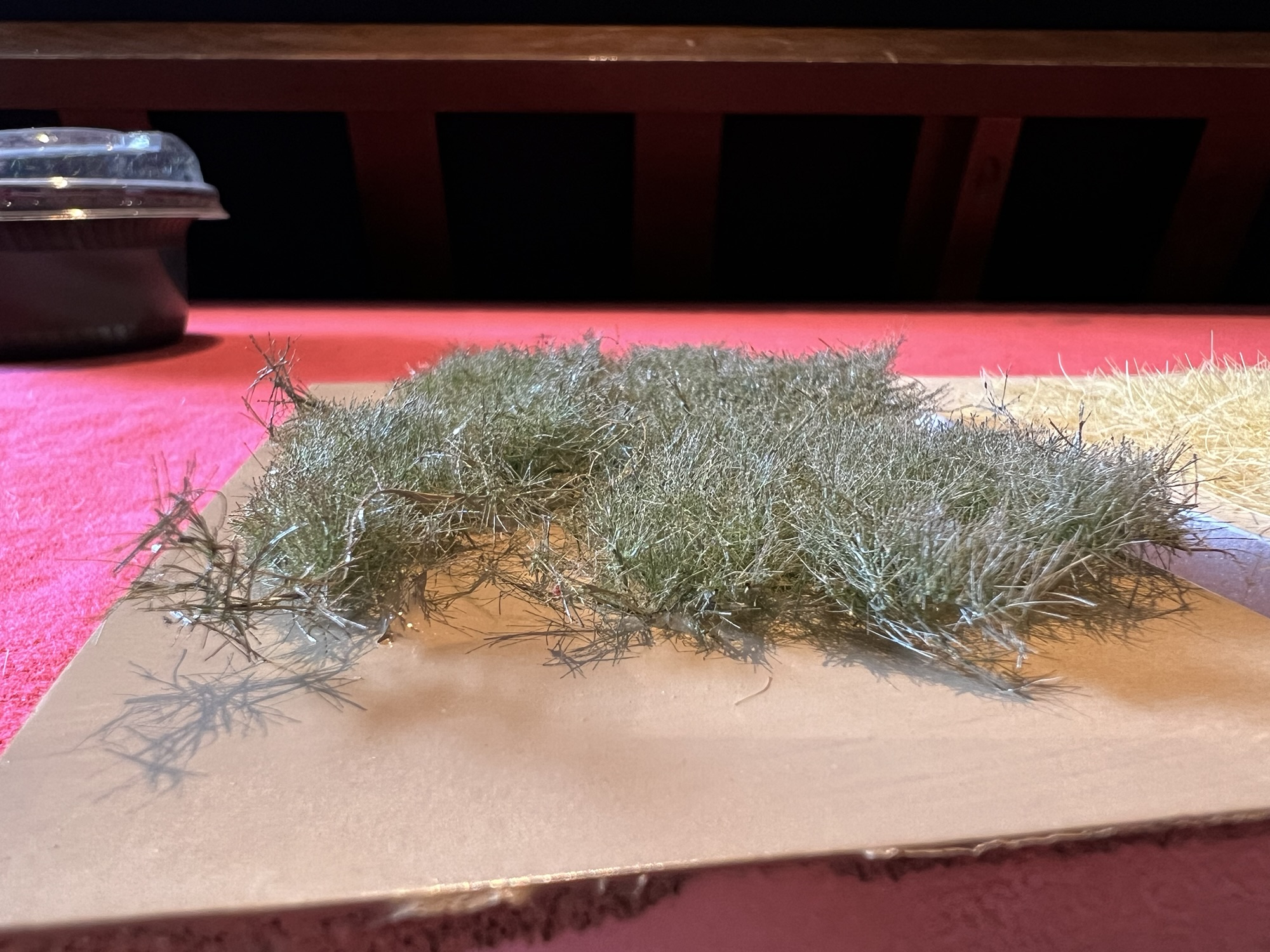
After cruising unsuccessfully around multiple online retailers for suitable static grass, I picked up a couple of bags of likely-looking fibers at InterCity Trains and Hobbies on Saturday. I planted a small patch of each on pieces of foam core, and then because I didn’t really like either, I mixed them on a third. That still didn’t seem tall enough, so I added another layer.

The Noch fibers are much finer than the Woodland Scenics ones, but I prefer the height of the straight Woodland Scenics. The mixture with the second layer is too random to represent a planted field, but would look great for wild grass. In all cases, the fibers are not straight enough to represent wheat, although the Noch was the best.
As the field is in the foreground, I’d like to represent the seed heads. The method does need to be time-efficient as I have quite a large space to cover. I mixed a little yellow ochre with acrylic modelling paste (a new favourite material) and dabbed it onto the tips of the fibers. While the colour needs to match the fibers, the added weight at the ends of the grass is, I think, worth the effort.

Looking at the photos, I may try another 2-layer approach. I think I have some 4mm straw, and perhaps with the 9mm Noch gold, we may have a winner.
 Pembroke:87
The folks at WWScenics use very short 1mm for their first layer, and buildup from that. So your plan to try a first layer of 4mm may do the trick.
The Boomer Diorama fellow pinches the long fibres in his fingers , aligns them all vertically and pushes one end of the bunch into matt medium. From what I’ve seen, he does some initial bunches and waits for them to dry. They serve as props and help holder later bunches vertical.
I’ve also seen folks use a static grass applicator in reverse, where the grass flock is drawn up from the desk to a glued surface. It puts gravity to work for you and from what I’ve seen on line, creates a nice grass matt. I have thought about picking up the WW Scenics box with that approach in mind . . . WWScenics Youtube video
I wonder about creating tufts that are long and narrow – like crop rows. With some trimming, you could place them compactly and create a thick bumper crop . . .