The area I’ve been calling the hay field, it turns out, is too large for one of the Silflor grass mats that I’ve been storing for over twenty years. I have two, and so there will now two fields, and I’m hoping one can be convinced to become wheat.
Then the question came up: should there be a fence between them? Nowadays, and for all my life, I think the answer would be “yes.” But what about in 1905? Fences are, after all, a big investment in labour, even if the materials come from the land, and you have to wonder what you are fencing in or out if one side is wheat and the other hay. And if the should be a fence, what type of fence should it be?
Musings like this usually turn into wasted time on the Internet. However, when the question is as specific as “would there have been a fence between two Ontario fields in 1905?” the Internet mostly answers with cat videos.
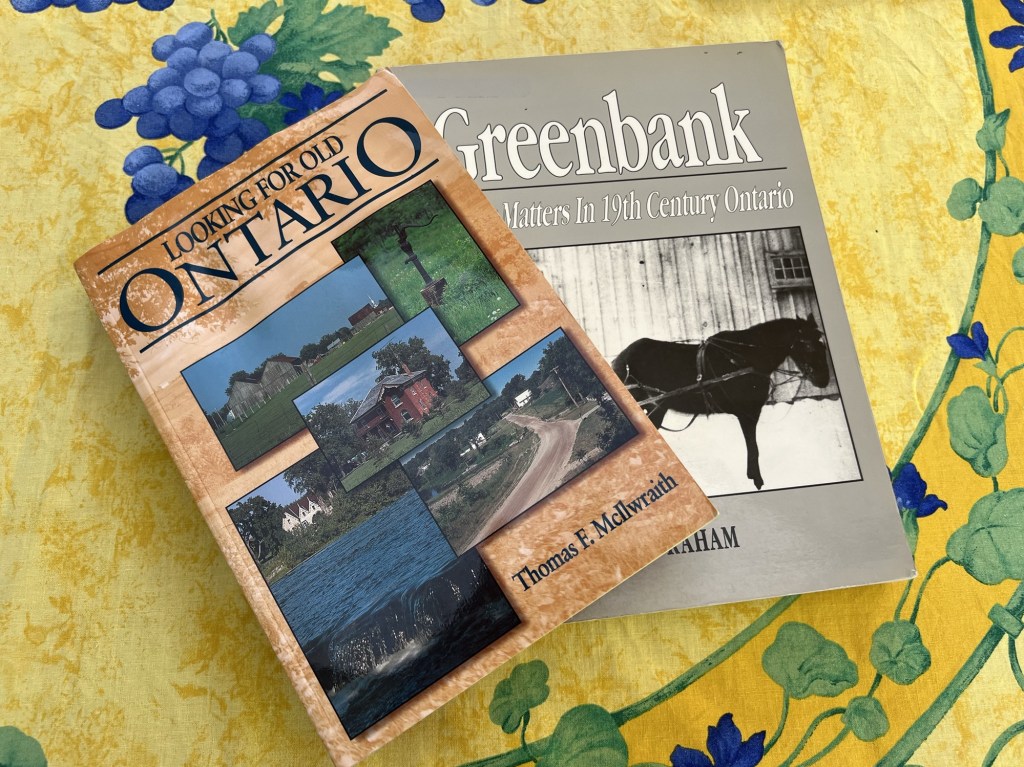
Fortunately I remembered that I have books! Two dusty denizens of my library were particularly helpful. Greenbank, by W H Graham, which I bought in 1994 for the princely sum of $9.95 according to the receipt helpfully marking some previous research, which does not refer to the Greenbank in Nepean where I grew up but one down in Durham County, and which I kept anyway because I’d paid $9.95 for it, came through with a page discussing fences in that tiny settlement. Looking for Old Ontario by Thomas F McIlwraith, which barely survived the floods of 2018, improved the page with a whole chapter devoted to fences.
So the answer is a definitive “yes.” Fences between farms were required even in the pioneer era so you could get your land title, and there were government inspectors to confirm your fences were fit for purpose. Interior fences within the farm enabled the movement of livestock; it was common to use hay fields as pasture, for example, after the hay had been gathered.
Looking for Old Ontario includes a handy map of fence types, dated 1881. The Pembroke Southern, according to this map, traversed an area where any type of fence will do, as long as it’s not stone. The chapter indicates that a snake rail fence would not be appropriate for a well-run farm by this time. So, it appears that Marc Simpson and I will be disagreeing once again over the number of rails that should be represented.