A few weeks ago, as I was contemplating the composition of Pembroke, I noted that I want to pull the viewer through the space between the Pembroke Milling Company and the CA freight shed. The existing mockups had their roof ridges parallel to the backdrop to simplify hiding the join with the backdrop.
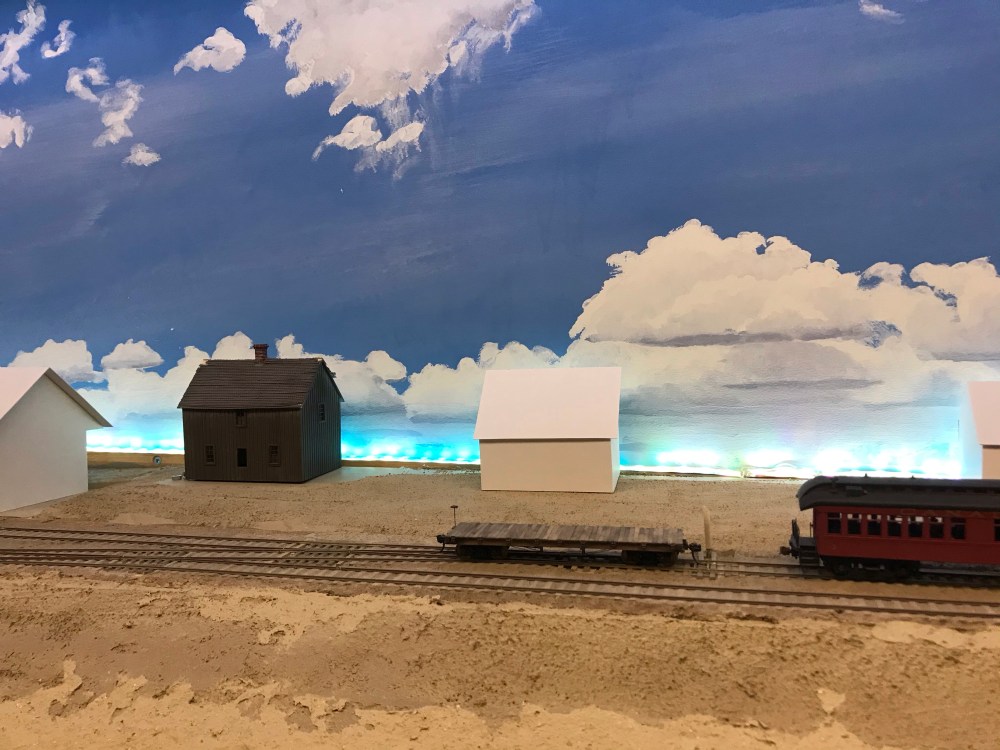
However, in actual fact, there were several houses here oriented perpendicular to MacKay Street (and the backdrop). I conjectured that using these, I could create a rhythm to help pull the viewer past the quiet space in the layout. Today, taking a break from #622, I mocked those houses up to see how they would play. The three mockups are identical, and maybe that repetition is too jarring – like that kid in the music store banging on a snare. Maybe some kitchens or sheds out the back could help to soften it to something more like soft brushes on the cymbals. At least I could make them look a little less like tobacco kilns.
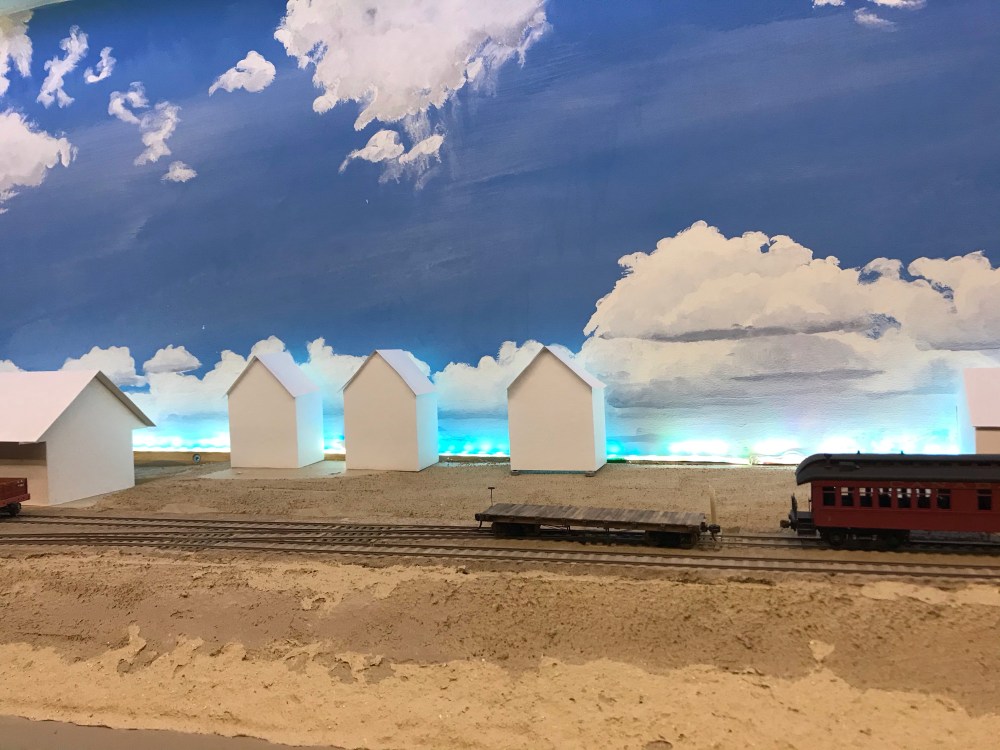
Which do you prefer? Two more complete buildings parallel to the backdrop, or three gable ends that run into the backdrop?
 Pembroke:87
A simple enough question but it really fired up my imagination,
This is a completely subjective reaction, but I think I like the side view houses due to space issues. I imagine the streets on which those homes would be built running perpendicular to the railway, and coming to a dead end at the railway property. The house lots are back to back – maybe with an alley separating them. If it was my neighbourhood, I’d fence the side yards and include a small gravel alley connecting the street ends (this side of the houses), and a bit of green space between the alley and the railway property. In this version, you have two street ends to model onto the backdrop, but with trees and fences, I think that’s manageable. This approach eats up a few inches of space front to back – maybe 7″ to 9″? A variant – one street end between the homes. Now the houses face front yard to front yard, and there is more width to the road. Both versions work better if you have some large trees to break up the roof lines.
What year are you modelling again? When was the first house built there? Could there be well established trees? Was anyone driving a car in town there? I wonder if everything i’m saying applies more 20 years later.
The houses with their backs to the tracks were initially easier for me to respond to. I’m assuming maybe a gable on one, different chimneys – even different roof lines. Out houses. Would there be a tree or two, large enough to give a more organic shape to it all – and so blend to your cloud shapes? , Assuming they face away from the tracks to a street that runs parallel to the railway? A plus – there is no street to project into the backdrop. I wonder if you might need at least one more house (just thinking ratio of property width to house width in “this part of town” won’t be generous. Downside – the houses will be longer front to back than oriented sideways, and the back yards will intrude further into the layout space than does a side yard. I can imagine no alley, but there would still be a green right of way between the backyards and the railway. Having trouble imagining this as less than 10 to 11 inches.
I’m not sure whether any of my comments are prototypical for that place and time, so “for what its worth”.
Thanks Rob. MacKay Street is parallel to the tracks somewhere inside the backdrop. Some trees were established in this neighbourhood by 1905, but not yet large. On the other side of the freight shed, there was a line of them, which I will use for another little rhythmic element.
If I recall, the first car was registered in Pembroke in 1905. I once even knew the name of the owner.
I like that you found the backs of the houses easier to respond to at first. I’ll keep them this way for a while and see how it settles.
Cheers,
Rene
The houses look good and, with some treatment to give each character, they will draw the eye to and through the scene. Were these the back of the homes or the front? Stairs, porches, outhouses, and chicken coops, etc. will all give these a company house look but have enough unique qualities to let them stand alone. The massing models are too uniform and rhythmic so think about the post and pier, open look and maybe less roof slope?
Thanks Neil, yes these are the backs of the houses. I’m not sure what you mean by “post and pier?”
Post and pier is the term for a home elevated on a wood foundation. I’m not sure if a basement or masonry perimeter foundation was common in Pembroke. If so, please ignore. The idea was to make the mass less so by adding details in front of, or in this case the rear, the dwellings. Fences, and such should help. Don’t forget the chimneys!
Presumably, the railway arrived before the houses were built and so they would all have been aligned with the tracks? If I were doing this freelance, I would do anything that I could to make it all less rectangular – the road and houses at a slight angle to the tracks, extensions and outbuildings not at right angles; anything to break up the squareness.
Best wishes
Eric
Great point, Eric. MacKay Street is perpendicular to Pembroke Street, which crosses the layout at about an 80 degree angle. So the left-most house should be closer to the tracks than the right-most.
Pembroke preceded the Canada Atlantic and was founded in 1828 as a lumber town. Canada Central (Canadian Pacific in 1881) got there got there first in 1876. I’m sure there were company houses around, but between the lumber barons, the CPR and other companies I’m sure they weree a fialy diverse lot. Getting back to Rene’s original question, I like the series of houses. Especially with human and animal figures around them It would create a dynamic view implying activity.
Thanks, Richard. I agree: these are unlikely to have been company houses; so no need to make them exactly identical.