You’d think that if your father had a doctorate in electrical engineering, at least a little wizardry might have rubbed off! Nope, he kept it all to himself, apparently.
The story starts with the Hall effect sensor, which the ESU decoder wants to synchronize the exhaust sound. Countless YouTube videos make this gizmo look trivial, but I couldn’t get it to work at all. If I wired it up correctly, the LED would remain dark, and no amount of waving magnets or rare earth or even cats at the sensor would convince it to light. Intriguingly, if I wired it up slightly backwards, the LED would come on, and no amount of waving would extinguish it.
I wired one up completely backwards, just on the off chance that I had drastically misinterpreted the documentation and the YouTube videos. Some magic smoke began to drift out, and I quickly abandoned the experiment.
In the end, I decided, maybe 622’s chuff can be timed for now. After all, the LokSound decoder I have is a micro version, which apparently knows less about Hall effect sensors than I do (I at least know they are named after Edwin Hall who discovered the effect in the mid 19th Century). So, the sensor would be dead anyway, which is just as well, because I seem to have only dead sensors.
Okay, one decision made, I thought I’d better put the whole contraption together and see if it ran on DCC power.
It didn’t.
Oh sure, the horn blew cheerily and the bell made a good din, causing every other model railroader in a fifty mile radius to remember that their locomotive should also be ringing its bell. But those sounds were entirely born by the tender.
No currents seemed to be getting to the locomotive. Except now that I think of it, there was the briefest of flashes from the headlight, which surged happily to life, realized I’d forgotten the current-limiting resistor, partied vigorously and flared out like a coke addict at Ibiza. It was such a short lifetime that I barely had time to notice it, and wondered until now if I’d dreamt that brief flash. But of course, that must have been the case because I did forget the resistor, and everything else went badly, so why not?
The engine itself stood mulishly still on the track, and turning the control up to 11 just made it dig in its heels all the more. Actually, that wouldn’t have been so bad: a reaction would have been welcome. No, it paid no attention whatsoever to the antics I was playing with the controller, and waving cats at that didn’t work either. After squashing all the micro connectors together some more, and still feeling no hint of even a whinny, I started metering the connection points to find the source of the failure.
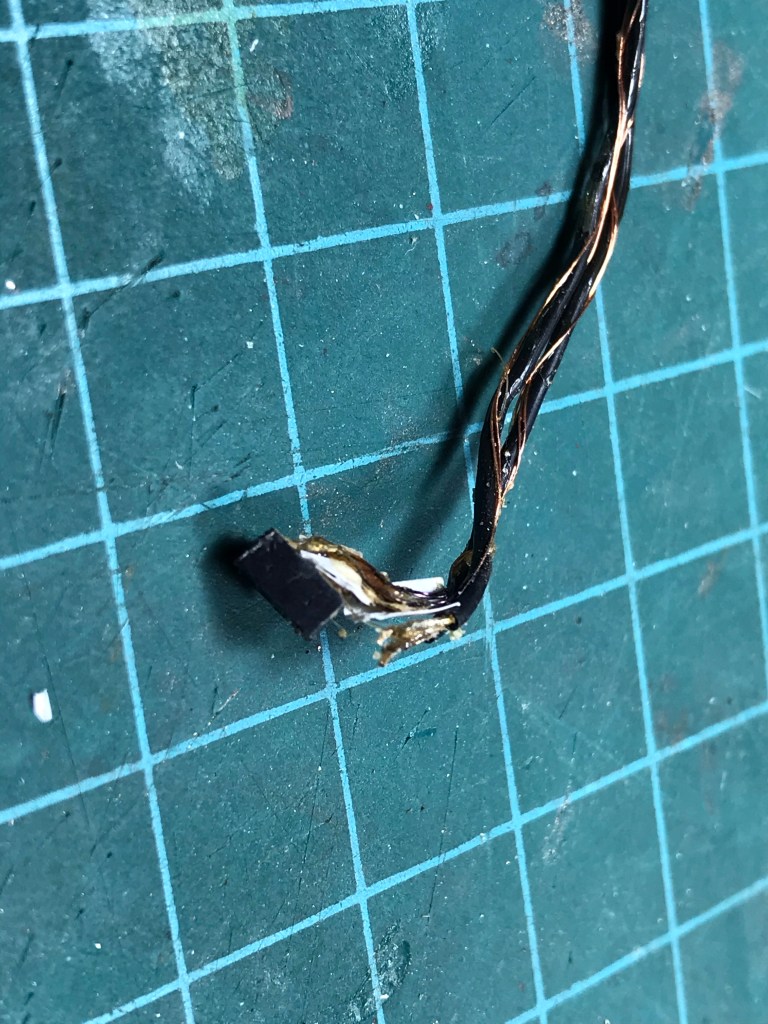
Sure enough, once I’d found the problem to be this weekend’s cable, it was obvious: the pins connecting the motor wires had failed completely. So much for tiny connectors and ten wires from the tender to the locomotive.
I think I will go back to the bigger connectors that were successful with #10, and just elide some of the fancy features. In addition to the timing sensor, I can’t figure out how to light the marker lights, mounted as they are on the handrails. So, actually two motor wires and two headlight wires will be enough for now.

 Pembroke:87
Does cat waving EVER work?
Your electronics misadventures sound a lot like mine.
Maybe I need a bigger cat?
What made the connector fail?
It’s about .1mm brass – pretty fragile to begin with, and apparently not happy with getting bent.
” . . . flared out like a coke addict at Ibiza.”
I enjoy the occasional delicious turns of phrase.
If you’ve brought out the cats, those are the big guns. No help for it but to go back to the drawing board.
Maybe sometime in the future you can detail what your ideal connector would look like, what material properties it would have, how you intend to access the components later on when they need maintenance, etc.
AH