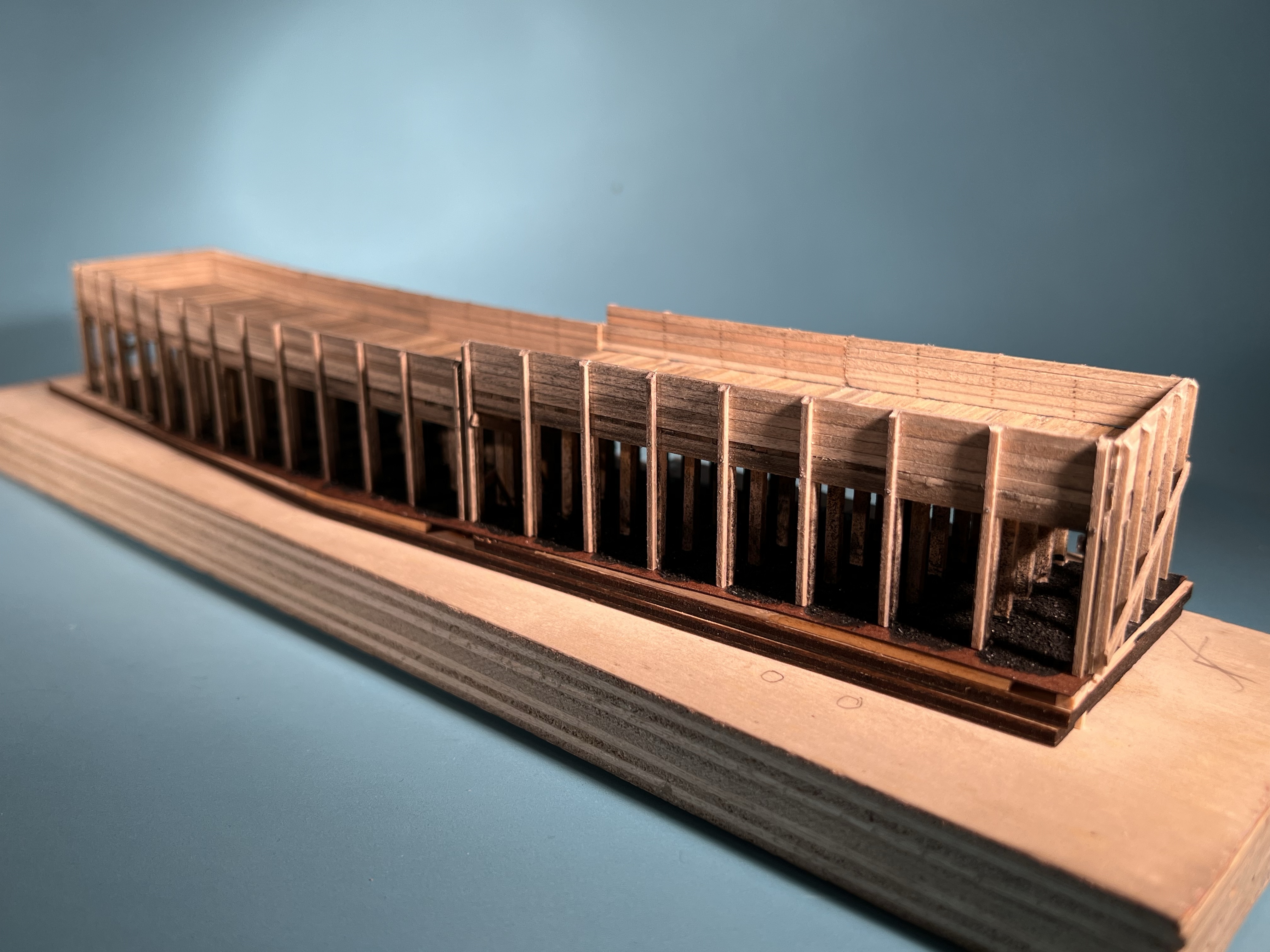
At what point does a coal dock become a coal bunker? Do the sides have to be higher, or does a bunker imply a less manual approach to moving the coal around? Regardless, these coal docks, at least those I’ve found information about all have at least three raised sides. My primary reference has four, and so the Pembroke coal dock does too.
The sides were a straightforward bit of modelling, with the caveat again that no two sticks of wood were exactly the same length, owing to the grade and curve of the service track. Each of the supporting posts extends almost, but not entirely to the ground, which rises beneath the structure. Meanwhile, each section of wall was about 16 feet, but no two sections were identical because the curve is a spiral easement; one end is nearly straight.
So it was a lot of cutting to fit, which went faster than you’d reasonably expect, thanks primarily to a relaxed attitude to getting the panels centred on their end stakes. The only cunning part was a little jig I used to centre the bolt holes on the posts and maintain a nearly constant depth below the deck.

 Pembroke:87
Nice job Rene! Isn’t a ‘Bunker’ a structure with a roof on it? You continue to be amazing with your thoughts and insights. Keep up the great work (and scenery too!)
Thanks Jim!
To attempt an answer to your question, could it be that the difference involves a chute? If you apply a nautical lens borrowing to the relationship between a ship and a dock, when you pull the locomotive up to a coal dock, you can fill it from coal at any point along the dock. If you pull the locomotive (or a ship) up to a bunker, generally there’s a defined spot in relationship to an outlet chute. Thoughts?