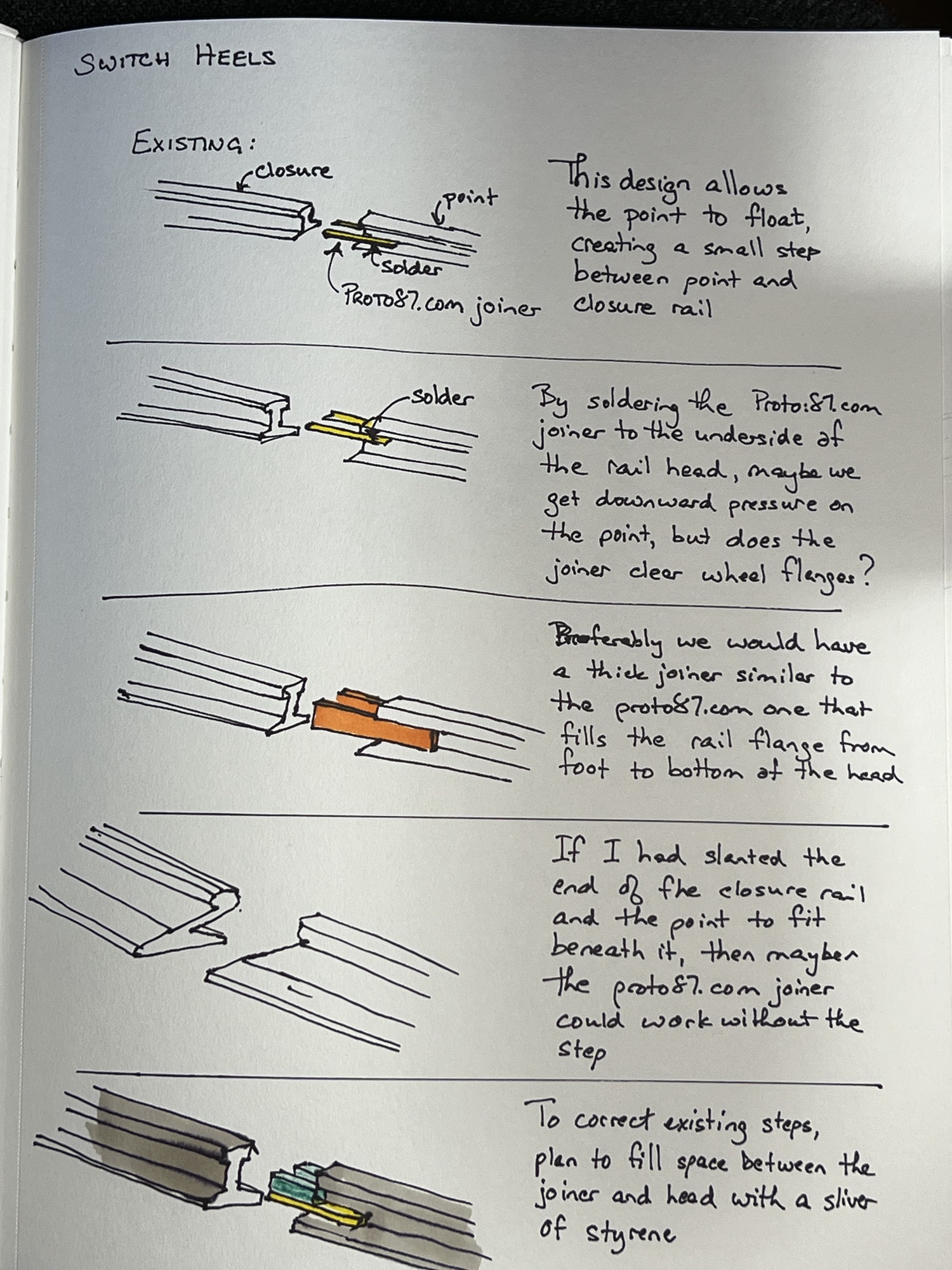
If I’m honest with myself, I shouldn’t be surprised by a derailment at the heal of a switch. The hinge, based on the clever but fine rail joiner from proto87.com, was the most expedient solution to an age-old model railroad problem that I could think of when I was laying track.
Considering this problem of the floating rail, I can think of a number of solutions. Sadly, only one of them lends itself to retrofitting on an existing point. The next time I build a layout, I will get some joint bars cast out of brass for the specific rail profile I’m using, including bolt detail.
 Pembroke:87
A question before you add the styrene bits. Have you bent down the sides of the rail-joiner hinge piece, or left it flat? I have bent the outer edges downward, thinking that helped alignment somewhat. When I look at your preferred joint bar solution, my bends get partially there. Something to try if nothing else?
No, I haven’t, Rob. It’s a good idea, but would require disassembly of the point, I think.
A solution that worked for me (using RP25 standards) was to have the point of the normally traversed route through a switch incorporated with the closure rail, and the point for the diverging route hinged with a rod soldered to its base. The rod is passed through the roadbed, via a vertical brass tube. Thus the more traversed route offers a solid running path to wheels, and one only has one potential source of derailment at that gap. This would allow you to use one of your joint bar methods at the gap of point rail/closure rail for the diverging route. It also allows the use of the method used by Trevor Marshall of Z scale turnout ties as throwbars. And he has a great method for hiding the throw rod attachment from Blue Point/Tortoise/Bullfrog/Cobalt switch machine.
https://themodelrailwayshow.com/2017/10/27/thinner-throwbars-in-rmc/
Steve Lucas
There are so many ways to skin this cat, it seems!