This morning The Algorithm pushed Stephen Travers Art at me, and because it is New Year’s Day and I have nothing better to do, except consume the remaining Christmas treats, take down the tree, put away the decorations, and a million other things, I clicked through to the suggested video to learn something while I procrastinated. Stephen Travers is an artist and his channel is about drawing, but his drawings include a fantastic amount of detail, and I thought his treatment of the topic might be relevant to our hobby.
You should watch the video too, and while you’re on his channel, check out the videos about drawing trees as they are likely relevant for us too. For my future reference, the key points are:
- Make some of the details more identifiable than others and position them near the front. Give them space or definition. Travers calls these “Eye Grabbers,” and they tell the viewer what they’re looking at.
- Give the eye places to rest and travel through the scene without being overwhelmed by detail. Divide the detail into digestible pieces. Travers calls the spaces “Fire Breaks.” They divide the detail into digestible pieces.
- Capture the essence of form; for example, a tree is composed of millions of leaves, but the overall shape of the tree is more important than the individual leaves. Diminishing the density and treatment of detail with distance also helps to create form.
- Be aware of negative space. Take advantage it to help capture the whole form or to further define eye grabbers.
- Silhouette edges – those at the boundary of the object – are important to establish the subject.
As a bonus, he also suggests that you complete the whole scene all at once, rather than, say, starting in a corner and working outward. When drawing the shadows, for example, he established them lightly and then came back to darken them once he knew the values across the whole work.
I’ve often said that accuracy is established by the details in our modelling, but realism is found in textures and colours in the spaces between the details. I believe another way to think about the “effect of detail” is the texture of detail. Scenery modelling is a great place to apply his techniques, but there could be others.
I really want more stuff on the porch of the grey house to tell the viewer something about the occupants. Given that this is a background model, I don’t feel I should model individual boots or make the detail stand out too much. What I really want here is the texture of detail, rather than the actual artifacts. Perhaps some of Travers’s ideas can be put to use here too.
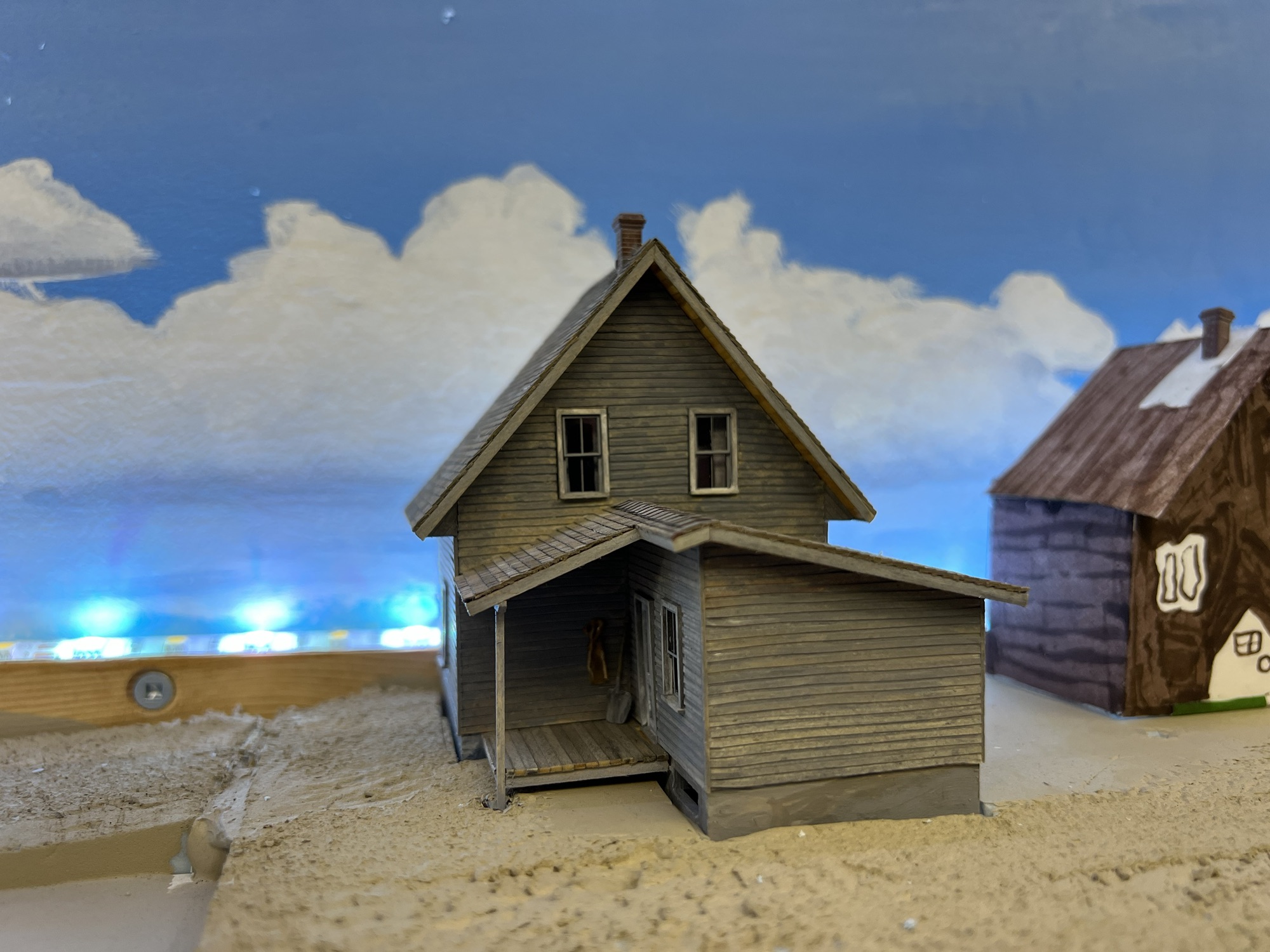


The back porch of Mary Street needs a large galvanized tub hanging on the wall, an old kitchen chair, and a wringer washer. If a Monday, there should be a figure of “the Irish girl” my maternal grandmother hired to do the washing while Granny supervised. Hence the chair.
Well . . . thinking about contrast and negative space . . . perhaps in the overall composition you are viewing that porch as a dark shadow. It presents an opportunity to be the negative space behind something more forward in the scene. Example: tall, white, sunlit flowers (daisies were big back then) in a small bed in the corner formed by the front edge of the porch and the porch wall at right.