When, after two years of social distancing, the Railway Modellers’ Meet met in person in 2022, all the clinics were online. That meant that the in-person part was only one day long, and consisted of on-the-spot content. We stole the idea of Birds of a Feather from technical unconferences, and have kept a slot like this, which we call “Meet Ups” ever since. This year’s “Meet Up” was themed around technology innovations and how they will change the hobby. My group had fun brainstorming about artificial intelligence, and we generated some ideas I had not thought about. About midway through, we asked ChatGPT to come up with ideas, but by then we’d already come up with almost all of them ourselves, as well as a few that it didn’t identify. At the end of the brainstorm, I fed the scrawled notes into ChatGPT to transcribe and summarize.
Here is what we came up with:
- Generate track plans using given inputs like geography, space, and prototype data.
- Render backdrops
- Create weathering effects, and texture paper for structures
- Developing code to run animation and other technical integrations such as RFID tracking on model trains.
- Fill in plausible missing data
- Generate logos
- Write a narrative for a freelanced railroad
- Enhance photographs
- Convert blueprints to 3D models for printing
- Synthesize entire plausible buildings
- Voice control
- Design timetables
- Write train orders, act as a “synthetic dispatcher.”
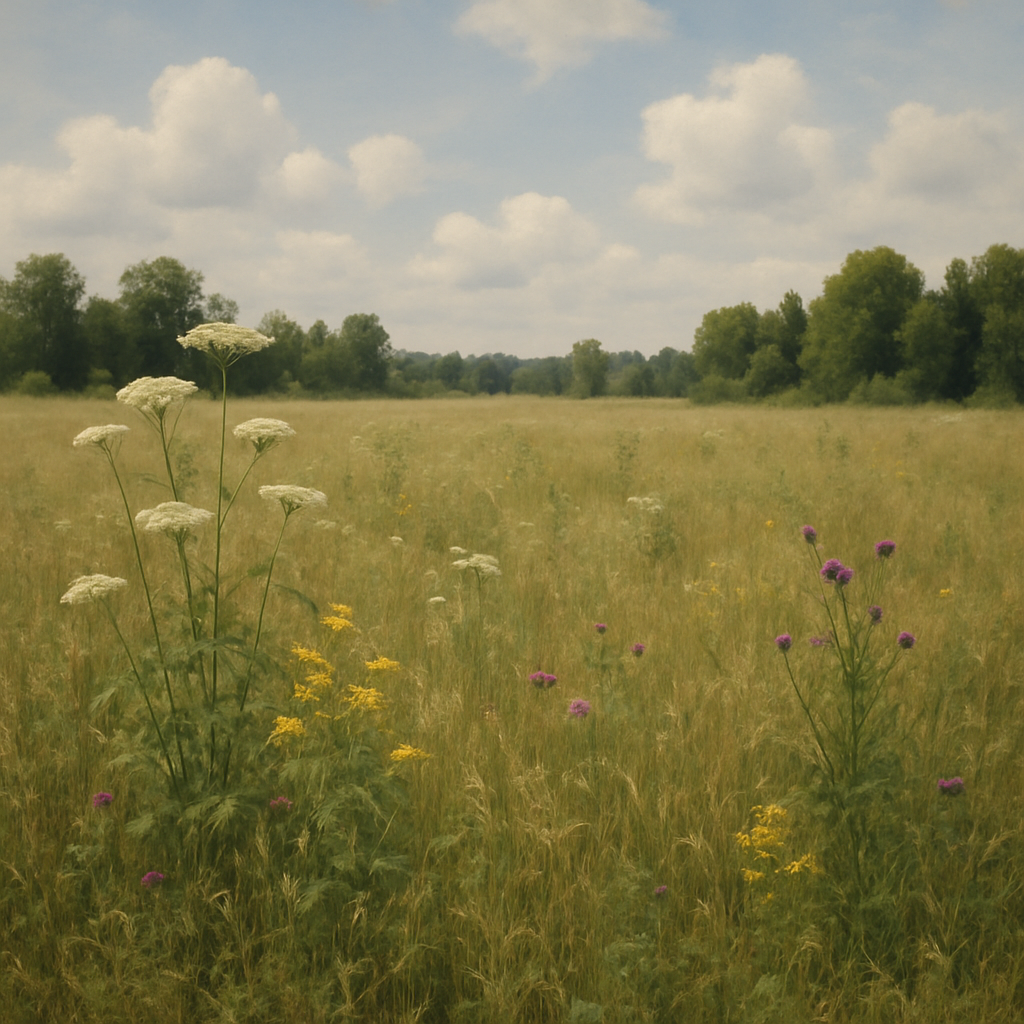
There it might have sat, except I’m thinking about the hay field right now, and my mum was staying in the train room so I couldn’t work on it directly. So, after a bit of searching the Internet for appropriate period photos, and finding nothing, I asked ChatGPT to generate a photo of a hay field, and also a wheat field, complete with appropriate weeds, as they would have appeared in late August 1905.
AI is a people-pleaser, and true to form, it came up with something that looks plausible, but may not be all that accurate. Also, true to form, the results are bland, and lack the richness and variety of real life; they are what I might have modelled if I didn’t have a real scene to work from. Still, it was an interesting exercise, and one that I’m certain will continue to yield better results over time.

 Pembroke:87
Looks like not much as changed since 1905, expect there are far fewer trees now-a-days! Love the idea of using AI to help with issues like this. I have used it to help write the backbone of several Arduino projects over the past year or so.
This is cool! I love this feeling: it never occurred to me; and then the feeling I am feeling now: I need to imagine harder.
I was, earlier this morning, reading a thread where someone was using ChatGPT to develop the CAD to permit 3D printing a figure from their 2D sketch. Again, an invitation to stretch the imagination to think, more.
Thanks for this.
—Chris
The bland backscene I quite like. Scaled appropriately and color balanced to the modelling it might be very useful. As it’s bland it won’t detract from the foreground, but may give a consistency in the print that’s hard to achive manually. I wonder if Ai could give colour tonal matching too?
Almost certainly it can, although you might run into colour balance issues between the photograph you take of the foreground, the generated image and the printer. There are also great possibilities in producing backdated backdrops. For example, if you had a prototype city photo from the 60’s, you could have AI colour it to match your foreground materials and also replace the cars with horses. You could probably also have AI change the view so that it’s from the right location.
I wonder what happens if you ask it to do a rainy day on this images it created for you? Does it stylise the weather, what sort of rain intensity it auto generates? Probably a whole rabbit warren not to go down there with those questions.. 🙂
Oh I’m certain you could do that, and control all the parameters you want “hay field in 1905 in a downpour” or “hay field on a misty morning just after the lark sings.”