Ballasting track is a well-known method for stopping it from working any longer. Most of the track on Pembroke was ballasted before any rail went down. The exception was the parts that are most likely to fail after ballasting – turnouts, specifically the switch.
Knowing the risks I faced, I took it slow and only ballasted one switch. The first switch, of course, as the train enters Pembroke, and the one that gets thrown on literally every movement. Things were going fine: I’d carefully wetted the area with alcohol, and mixed up some glue, but when I applied the glue, it didn’t want to settle into the ballast. I added more moisture, then a little more, and then left it for a bit, and threw the switch back and forth a number of times while the glue was setting. Then I went to bed.
By morning, the switch was no longer serviceable. The glue is just white glue, and it should succumb to re-wetting, but I’ve spent hours over the course of many sessions this week wetting it, manipulating the switch stand, and pushing the points over by hand. After a few hours of this, one of the points let go. I went to bed again.
Nobody remembers because it was early in the life of the layout, but the first two turnouts are actually on the window sill. There is a cunning mechanism rabbetted into the underside of the 1/2″ roadbed transmits the motion from the Bullfrog beneath the layout to both the switch rods and the switch stand. Even I don’t recall what it looks like, and I can’t find a photo to help. I’m hoping that is not the problem!
To make matters worse, the glue never did settle into the ballast properly, and remains on the surface as a shiny sheen. That evening of ballasting will live in infamy as one of my least successful railroading nights!
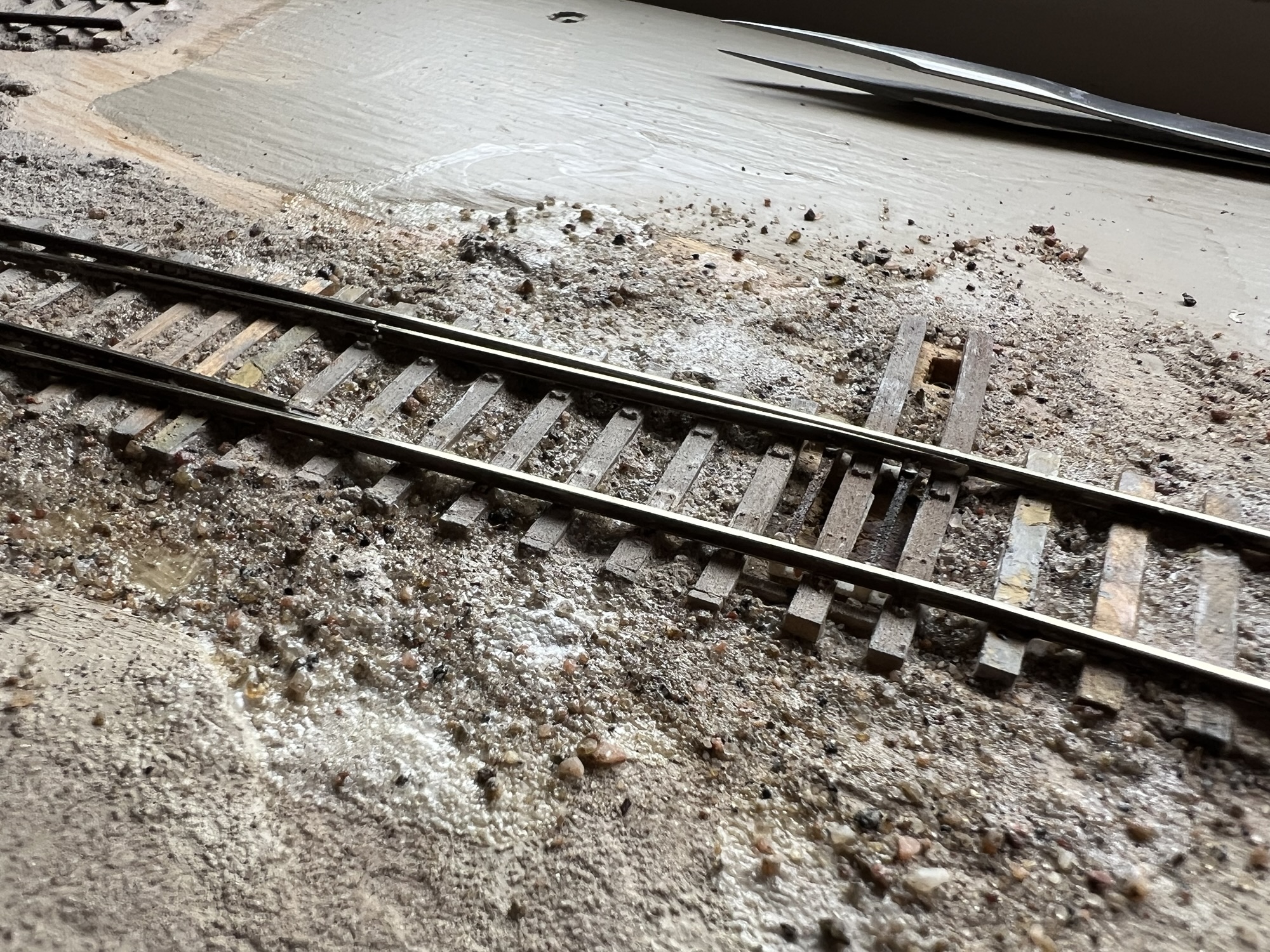
 Pembroke:87
FYI , I find a few drops of dish detergent in a fine spray wets down ballast and lets the 50/50 white glue and water (sometimes 60/40) penetrate the ballast leaving no crust. Elmer’s Glue-All has the least sheen of all white glues according to Greg Madsen’s tests and my experience. Pretty flat. Have rags and paper towels near to contain and absorb surplus H2O. I put a wee drop or two of oil on moving parts of turnouts and check movement during the drying. Sorry to hear about the mechanism stiffening. Maybe right where ballast meets the metal? And yes, scanter ballast at turnouts.
Get Outlook for Androidhttps://aka.ms/AAb9ysg
I feel your pain. I’ve glued up too many switch points in my time.
If hand-laying, there’s an argument for ballasting under the switch points before laying the rails.
Or, paint the roadbed a ballast colour under the points, brush full-strength white glue between the ties, pour over some ballast, let dry, then vacuum up the excess. That’s worked for me too.
Good luck fixing this and do let us know how it works out!
Well that is painful!
I wonder if the saturation & appearance issues arise from our current summer weather? Something about humidity, drying time, etc.
My own experience is with a dilution of something closer to 10% white glue to 90% water, applied more than once if necessary.
I’m not sure isopropyl alcohol or Windex will help to break down locked up parts, but suggest both products are worth a shot.
I am also just realizing that when the point came free that may indicate a broken switch rod attachment. Is that the case? Or is it a simple thing to snap the point back into place?
The points are held to the switch rod with glue, and the clips on the rod are designed so the joint is in compression when normal forces are applied. Unfortunately, prying the point off the closure rail was not a normal force! It’s happened before during all of the work I had to do to get these turnouts running reliably, though, and repair is simple.
You’re being very diplomatic about this. I can only imagine the words and their feelings that would be floating here.
I remember reading an article where the modeller was applying a small amount of oil in the areas of a turnout most likely to absorb glue and get themselves glued shut. I never tried it but often think about the idea.
Will it be possible to remove parts of the turnout incrementally to examine what might be the problem or is it a case of scraping the whole thing up to start again?
Chris
Oh, it would have been much worse than scraping up the turnout, Chris! With the mechanism sandwiched between the window sill and the roadbed, I would have had to excavate from above or uninstall the module!
Fortunately, last night, I injected enough water and alcohol into the mechanism that it started to move. It’s not 100% yet, but a couple more days of fiddling should free it up, I think.
Rereading that summary of the work here underscores just how miserable that work would have been. This is fate’s cruel hand recognizing exactly why it would be this particular turnout that would be glued shut.
I am thrilled to read the update that it is starting to free up. This is encouraging.
And it’s probably just one tiny spot of glue in exactly the right place. We envision a mechanism entombed in a solid block of glue but it always seems to be one tiny drop precisely in the right place—“right place; right time”.
Chris