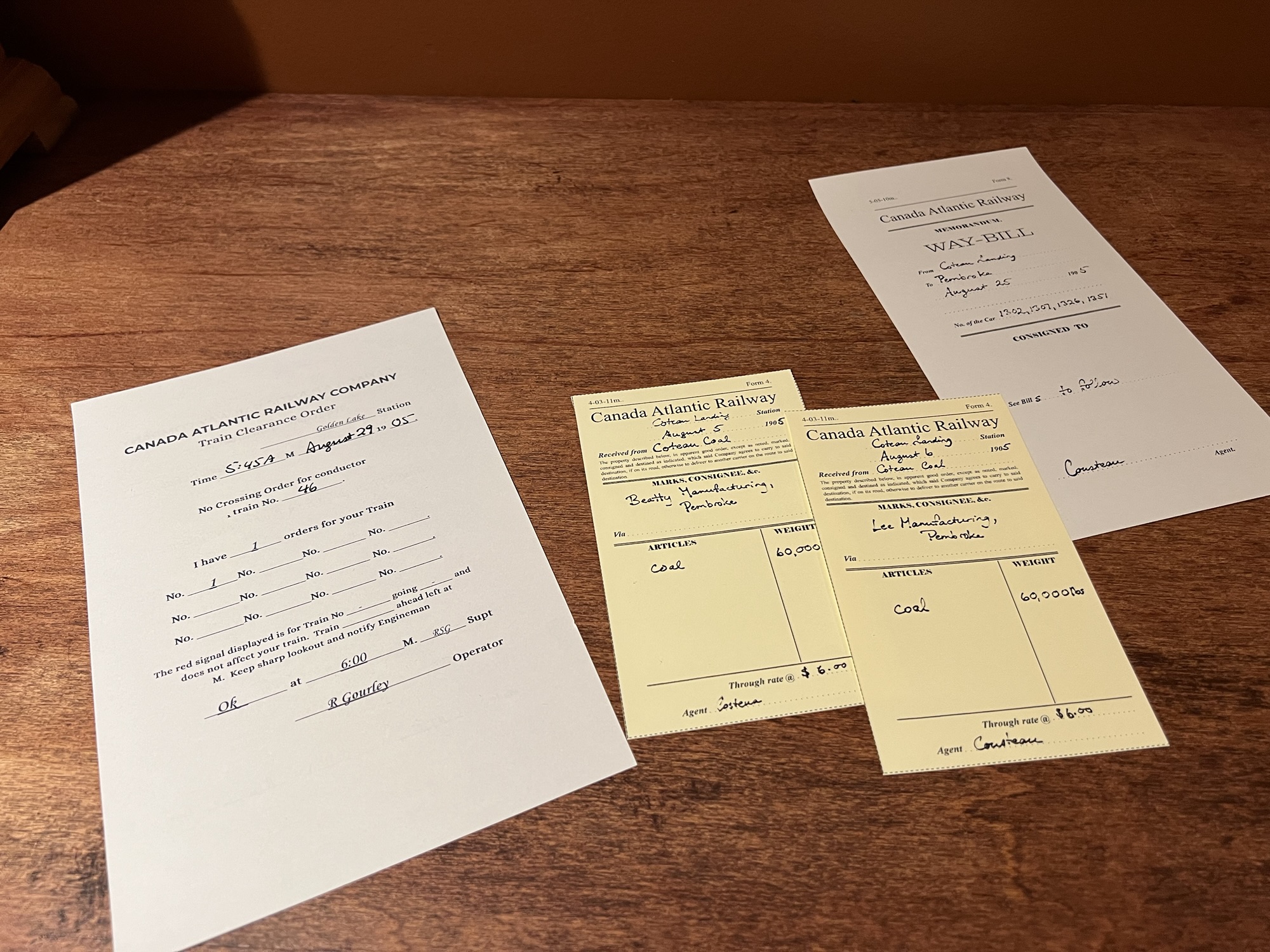
It sounds serious, but actually it makes me laugh: nothing moves on Pembroke without a reason. Every train that passes over the rails does so with authority, after signing the register, of course. And, I only airlift equipment onto or off the layout without running it to Golden Lake first if it breaks catastrophically. Until recently, that meant a worrying lack of freight revenue. I had a way bill, which I used for shipping a carload of sand for company service, but no source for traffic.
1905 is, as far as I can tell, a little before the introduction of standardized forms for railroad waybills. In later years, agents (the old kind, when Claude was a guy with a handlebar moustache, round glasses and a love of thin cigars) would transcribe information from the bill of lading to the waybill. The bill of lading is the contract that says the railroad has received the shipment and promises to deliver it to the receiver in the condition in which it was received for the prescribed rate. In my era, a copy was often mailed to the receiving agent, who could coordinate reception with the consignee. The waybill, which travelled with the car, would list the consignee, but not the contents or the shipper. It would refer to the bill of lading, but often said something generic like “to follow.”
I could easily skip the whole bill of lading and just stick with waybills, but you need a way to generate realistic traffic. So, after looking at bills of lading for a number of contemporary roads, I designed a slightly simplified version for the Canada Atlantic. My idea is this: at the beginning of each day, I will roll a die to decide how many shipments to make. I will then draw that number of bills of lading from a deck of bills. Some of these will originate off the layout, in which case, I will find a car that has arrived at Golden Lake. Those that originate on the layout will require an empty car. If the agent has an empty car in Pembroke, we can use it. If not, we order one, which should probably take a day to get to Golden Lake.
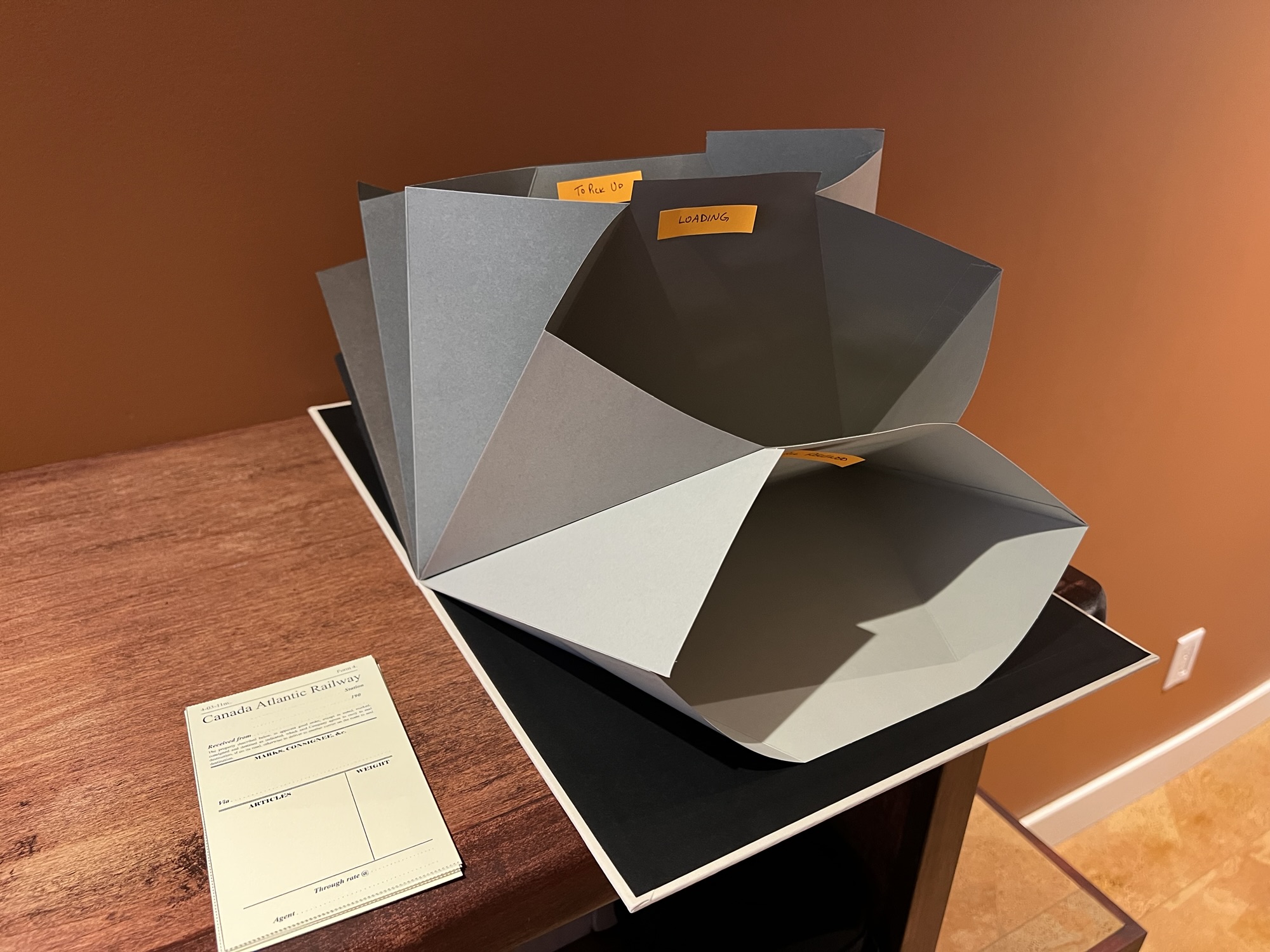
To keep track of all these bills and the states of cars, I picked up a pair of bill files from Staples – one for Pembroke and the other for Golden Lake. Each of these has a half-dozen pockets, which I think should be sufficient for my needs. I labelled three of the pockets “Received,” “Loading,” and “To Pick Up.” We shall see if these temporary labels stay as the scheme evolves.
First, though, we need a lot more rolling stock!