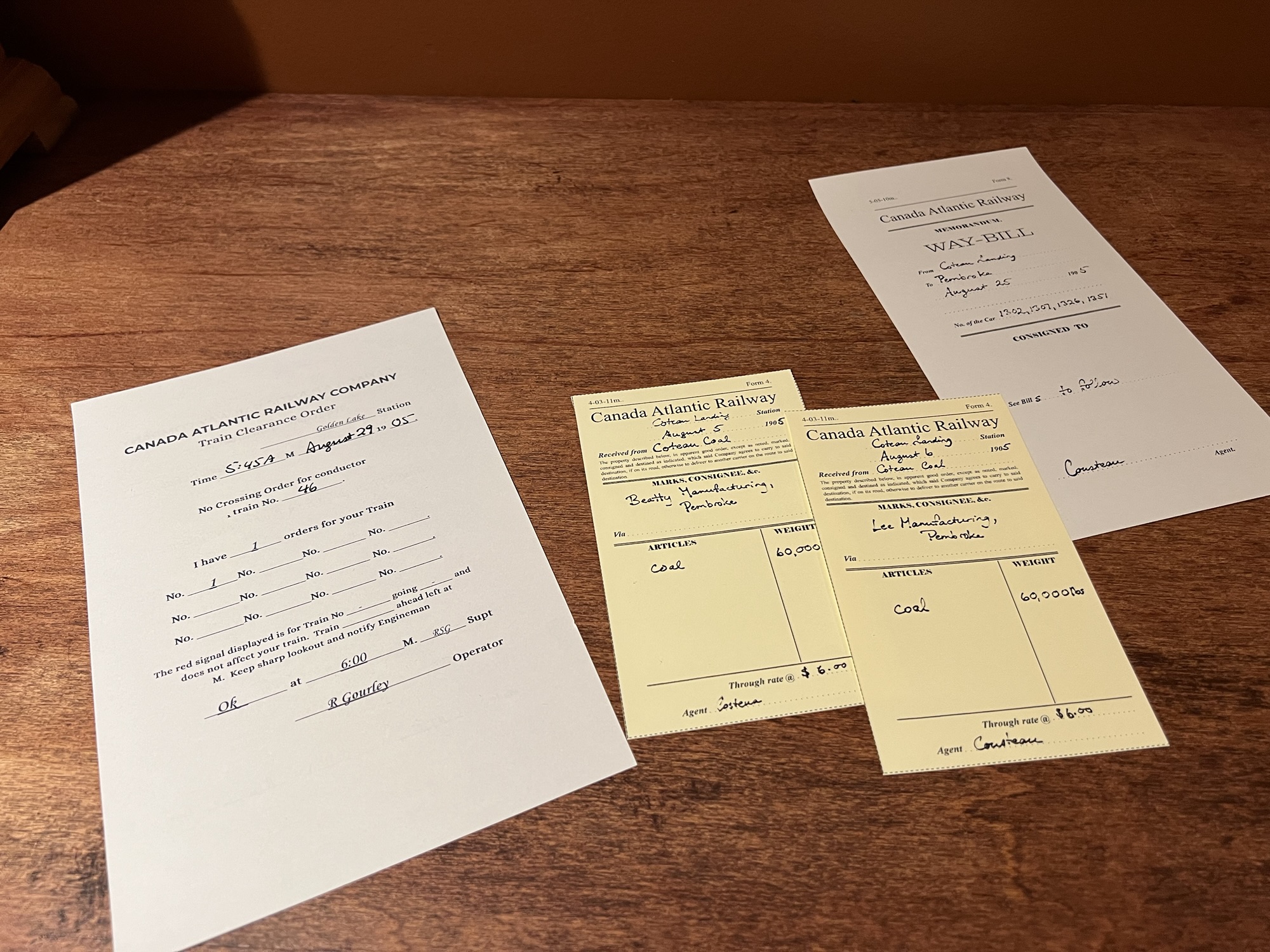
It sounds serious, but actually it makes me laugh: nothing moves on Pembroke without a reason. Every train that passes over the rails does so with authority, after signing the register, of course. And, I only airlift equipment onto or off the layout without running it to Golden Lake first if it breaks catastrophically. Until recently, that meant a worrying lack of freight revenue. I had a way bill, which I used for shipping a carload of sand for company service, but no source for traffic.
1905 is, as far as I can tell, a little before the introduction of standardized forms for railroad waybills. In later years, agents (the old kind, when Claude was a guy with a handlebar moustache, round glasses and a love of thin cigars) would transcribe information from the bill of lading to the waybill. The bill of lading is the contract that says the railroad has received the shipment and promises to deliver it to the receiver in the condition in which it was received for the prescribed rate. In my era, a copy was often mailed to the receiving agent, who could coordinate reception with the consignee. The waybill, which travelled with the car, would list the consignee, but not the contents or the shipper. It would refer to the bill of lading, but often said something generic like “to follow.”
I could easily skip the whole bill of lading and just stick with waybills, but you need a way to generate realistic traffic. So, after looking at bills of lading for a number of contemporary roads, I designed a slightly simplified version for the Canada Atlantic. My idea is this: at the beginning of each day, I will roll a die to decide how many shipments to make. I will then draw that number of bills of lading from a deck of bills. Some of these will originate off the layout, in which case, I will find a car that has arrived at Golden Lake. Those that originate on the layout will require an empty car. If the agent has an empty car in Pembroke, we can use it. If not, we order one, which should probably take a day to get to Golden Lake.
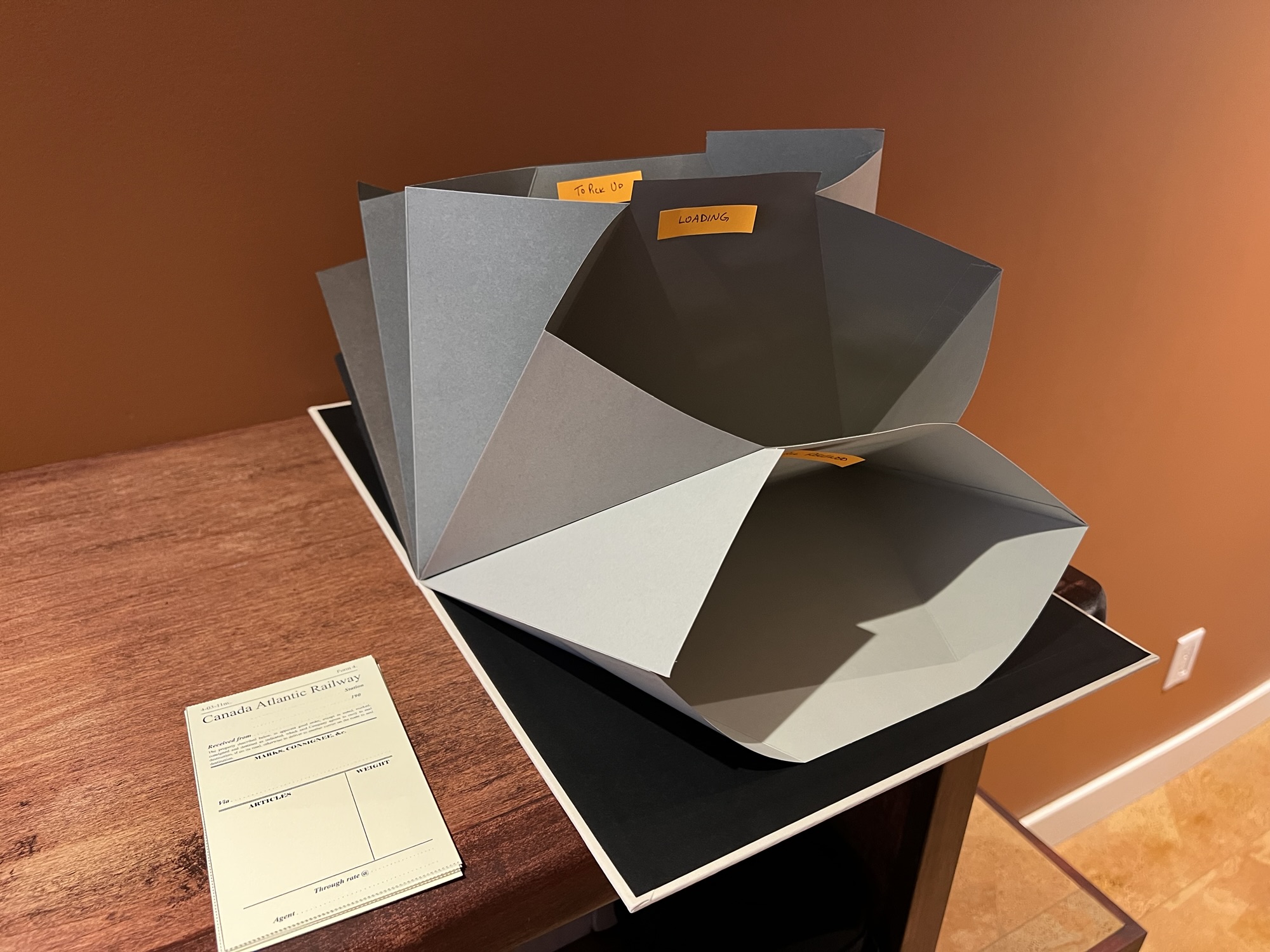
To keep track of all these bills and the states of cars, I picked up a pair of bill files from Staples – one for Pembroke and the other for Golden Lake. Each of these has a half-dozen pockets, which I think should be sufficient for my needs. I labelled three of the pockets “Received,” “Loading,” and “To Pick Up.” We shall see if these temporary labels stay as the scheme evolves.
First, though, we need a lot more rolling stock!


It’s interesting to read about the emergence of standardized forms for railway waybills. I’ve just been reading through a list of correspondence of the Railway Commissioners of Canada in 1904 and 1905. Was not looking for anything related to this subject, but what I did see was fights over freight tariffs and new rules requiring railways to publish tariffs – that sort of thing. The commission was still pretty new, and every Tom, Dick and Claude – and their local chamber of commerce – was asking the commission to judge on. this or that perceived inequity. Fascinating time – although as tedious a type of research as I’ve done in a long time . . . Still the emerging paperwork of the era was something I was noticing before I came to your blog this evening.
Hi René,
Out of curiosity, when you say that a copy of the bill of lading would be mailed to the recipient, does that mean the copy has to be put into the postal system, and it would then travel out on the railway network, for sorting, routing and delivery?
I am fascinated by the implications of timescales in this: it seems possible that the mailed copy could arrive after the load was delivered, meaning extra time spent with the freight car (if a full load) sitting in a spur somewhere, but presumably any LCL traffic would be stored at a freight depot at the destination, if it arrived before the copy of the bill of lading?
Operationally, this suggests that some freight cars might stay around for an extra day or two, waiting for the consigned to turn up, having received the notification.
(In the UK, goods traffic was typically allowed a maximum of 3 days for unloading, unless in a private siding. Most railways would deliver overnight (shorter distances) or perhaps take one day longer, but the mail was usually next day, too, I think.
I personally find when operating that if I assign a mental note of the load for each wagon in an arriving goods train, then my shunting is more enjoyable for me – and this seems to create an sense of order/reason/meaning to the operations for the observer. (I have been asked more than once if I was using a car routing system!)
Let us know how this develops!
Simon
That is, I believe how it worked, yes. Remember that in these days, the mail moved by passenger train, while the freight moved by freight trains. So, the mail would inevitably get there first. I believe the bills would have been mailed to the agent at the receiving station, rather than the consignee. The agent would then send a delivery notice to the consignee.
In North America, you had a day in which to unload the car. After that the railroad could charge you a daily rate to keep the car. Of course, figuring out who had a car so you could charge them the per diem rate required an army of clerks operating in a system that was just emerging in the time I’m modelling. Prior to this time, the rules governing car movement and charges were even more pliable, and it was not uncommon for cars to just disappear altogether for years at a time. The railroads employed detectives who went around North America looking for their cars.
Thanks for taking the time to expand on this, René.
Interesting comparisons with the UK. I am not totally on top of the process of sending the various paperwork out to customers, but typically they had 3 (business) days to unload their wagons, and thereafter would be charged “demurrage”. Or rather, should have been charged. It appears that this didn’t always happen, for example at New Radnor a small one-man-band local coal trader might take up to a month to dispose of the contents of a single coal wagon, and the porter in charge took pity on him and didn’t charge him!
This doesn’t mean that once empty, a wagon would be whisked away for further use: the impact of the “common user” requirements on railways meant that they usually had plenty of empty wagons available just in case someone turned up with goods to be shipped out.
Yes, that sounds all very similar. The management of empty cars is one of the aspects that interests me with this scheme. When a load shows up in Pembroke, we may or may not need to order a car far it, depending on what we have on hand.
Great to see this progress and love the prototypical paperwork and process for generating traffic!
Thank-you!